Tag Archives: Village Voice history

“Barrett on Trump”
Early Warnings: 1970s-2010s

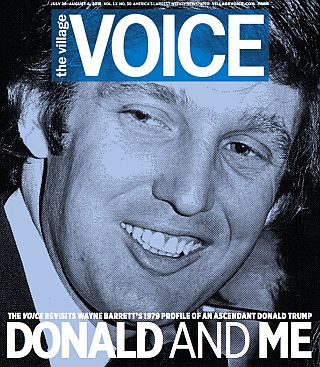
July-August 2015 edition of “The Village Voice” – shortly  after Trump began his 2016 presidential bid – revisited historic 1979 reporting by Wayne Barrett, which covered Trump’s shady deal-making on earlier NY city projects.
July-August 2015 edition of “The Village Voice” – shortly after Trump began his 2016 presidential bid – revisited historic 1979 reporting by Wayne Barrett, which covered Trump’s shady deal-making on earlier NY city projects.
Wayne Barrett (1945-2017) was an American journalist who worked as a reporter and senior editor for The Village Voice for 37 years, between 1973 and 2011. He became known as a leading investigative journalist covering power and politics, especially in New York City. He held degrees in journalism – a bachelor’s from Saint Joseph’s University and a masters from the Columbia University Graduate School of Journalism, where he would later teach as an adjunct professor for over thirty years.

Barrett was best known for his reporting on, and books about, New York politicians such as Rudy Giuliani and Ed Koch, and also, Donald Trump. Other targets included Roger Stone, advisor / troublemaker for Richard Nixon and Donald Trump; New York Governors Mario and Andrew Cuomo, Rev. Al Sharpton, former U..S. Senator Alfonse D’Amato (R-NY), and Roy Cohn, lawyer and Donald Trump mentor and enabler.

Barrett, in fact, was the first journalist to uncover, in some detail, Donald Trump’s early New York business practices, insider deals, and deceptions. He began reporting on Trump in the late 1970s when he focused on two prominent Trump-related real estate development projects in New York City — the Hyatt Hotel in midtown, and a proposed convention center on the West Side.
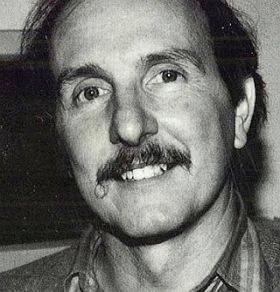
1990, Wayne Barrett, investigative reporter for “The Village Voice” of New York.
Barrett’s early work on Trump included 10 hours of taped interviews with Trump while the Grand Hyatt was under construction. His two-part, January 1979 series on Trump’s projects for The Village Voice led to the impaneling of a federal grand jury in the Eastern District in Brooklyn against Trump.

On January 15th, 1979, The Village Voice published the first part of Barrett’s Trump story on its front page, – “Like Father, Like Son: Anatomy of a Young Power Broker” (photo below). That story was Barrett’s opening salvo on Donald Trump, covering his origins, connections with his Brooklyn-based real estate father, Fred Trump, and Donald’s early rise into his Manhattan real estate ventures. Barrett uncovered potential racial bias and the use of massive tax breaks in some of the Trump ventures. He exposed the political connections of Fred Trump, showcasing how Donald followed and leveraged his father’s political ties – and not least, those with New York Mayor Abe Beame, who would help Donald with his Manhattan projects.
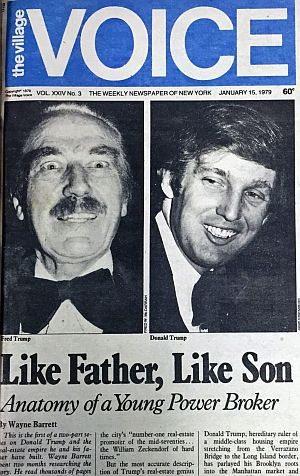
First of a 2-part story on Donald Trump real estate connections with his father in Brooklyn, Jan 15, 1979.
Barrett’s stories on the Hyatt and West Side projects for The Voice described how then-Mayor Beame, and others at the top of the political establishment bent over backwards for Trump to help him develop a property owned by the Penn Central Railroad where the multi-million-dollar convention center would rise. Through hefty tax incentives and guaranteed loans, the city offered Trump a chance to leverage public risk for his own private profit — without putting up a dollar of his own money.

Early on, during the course of Barrett’s investigations, Trump learned of Barrett’s sleuthing, and surprised him with a telephone call out of the blue.

Barrett at the time had filed a Freedom of Information Act request and was by himself in a secure conference room at the offices of the State Urban Development Corporation working his way through thousands of pages of state and city records. It was then that a telephone began ringing in a nearby empty conference room. While Barrett hesitated at first hearing the phone, he did answer it, only to here a voice on the other end say: “Wayne! This is Donald! I hear you’re doing a story on me!”

Barrett was stunned at Trump’s call, since he thought no one really knew he was at that office. It turned out, however, that some insider or clerk at those offices had tipped off Trump that a reporter was looking into his files.

But the phone call to Barrett was classic Trump, designed in part to show Barrett that he had “long reach,” knew a lot of people, and could be a kind of unseen, hovering presence. Still, Barrett engaged with Trump, met with him, and would do a series of some 15 interviews with him while working on his Trump Manhattan project pieces for The Village Voice. Trump, meanwhile, would push the envelope with Barrett.

“…You know, Wayne, you don’t have to live in Brownsville. I can get you an apartment.”
    – Donald Trump phone call
During Barrett’s reporting, Trump tried to influence Barrett’s work in various ways. First he tried to be chummy with the reporter, and also tried to bribe him, subtly hinting that he could get Barrett a nicer apartment in midtown and move him and his wife out of the Brownsville home where they lived. Of Brownsville, Barrett would later note: “It was the poorest neighborhood in the city. But both [my wife and I ] were young radicals. We were doing all kinds of organizing there. We published a paper called The People’s Voice. We were doing it as a political thing. But of course, that was completely beyond his [Trump’s] comprehension. He had checked this out… And he says to me, in the interview, ‘You know, Wayne, you don’t have to live in Brownsville. I can get you an apartment.’ So he had the bribery and the threat thing flowing full scale.”

But when that didn’t work, and Trump realized Barrett was uncovering some unflattering history, he threatened to sue Barrett, also invoking the name of Roy Cohn, his pugnacious lawyer and politically-connected mentor.

January 22, 1979 - “Donald Trump Cuts the Cards: The Deals of a Young Power Broker,” by Wayne Barrett.
But Barrett’s work rolled on. A second installment of Barrett’s reporting on Trump came on January 22, 1979 with the headline — “Donald Trump Cuts the Cards: The Deals of a Young Power Broker.”

Barrret’s other investigation into early Trump came with Trump’s move to replace the old Commodore Hotel at Grand Central Station with another hotel, a development that would become the Grand Hyatt. For this Trump project Barrett published another Village Voice piece on February 26, 1979, headlined “A Seamless Web,” in which he detailed a number of the players and dealing involved, but honed in especially on the role of Donald Trump, as he explained:

…In previous stories, I detailed the conflicts and serpentine relationships that made up Trump’s convention-center deal (Voice, January 22), but in acquiring the contract for the Commodore renovation, Trump outdid himself. He persuaded city and state officials to designate him developer on a site he didn’t own — or even have an option to own. Later, he got a binding lease and acquisition agreement from the city and state, though he had no financing commitment to back him up…. ( The Commodore caper is part shill game, part intrigue. Its apologists make it part soap opera. But the size of the deal’s subsidies — it is perhaps the most costly incentive project in city history — make it news )….
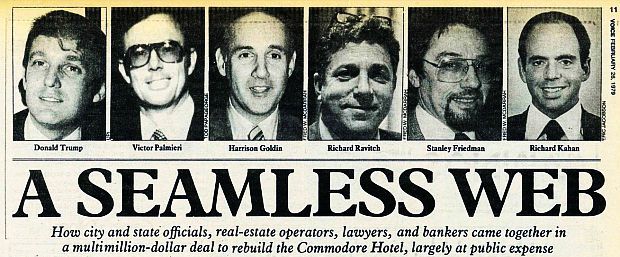
Top-of-page layout with photos of principal players and headline for a Wayne Barrett piece published in The Village Voice, February 26, 1979, which detailed the roles of various players in what would become the Grand Hyatt development project, and especially the role of Donald Trump.

Barrett later explained in a June 2016 Vox.com interview how his early relationship with Trump changed after Trump realized he was getting to some damaging truths about his deal making with New York city projects:
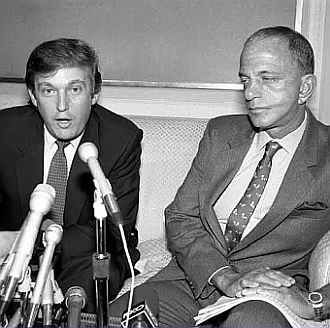
Donald Trump and his lawyer, Roy Cohn, circa 1980s. Cohn became a “Svengali”-type mentor/advisor to Trump, who counseled an aggressive, double-down, never-retreat style, which Trump adopted in both his business and political careers. Click for 2026 book on Roy Cohn.

…The early pieces that I wrote about him resulted in a federal grand jury in the Eastern District. He could see what I had found about his two earliest deals. By the time we closed out the interviews, he was aware that I’d caught him in a few things that could be very disturbing to the public image he was then trying to craft. Obviously he didn’t get indicted, but I had the goods enough to raise real ethical questions about his conduct.

That’s when he started taking me seriously… I think he just thought I was a guy he could play with. He got a lot less chatty. And then we get the libel letter — Roy Cohn sent a libel letter to the Voice before the first piece was published. So that was the one-two punch….

Roy Cohn. New York lawyer, Roy Cohn, became a key influence on Trump. Cohn was previously famous in the 1950s as a manipulative congressional aide to Sen Joe McCarthy’s communist witch hunts that terrorized America, and ruined numerous civil servant and Hollywood careers before McCarthyism self-immolated. “…if you could sit down with Roy Cohn and be charmed…there was something wrong with you.”
    – Wayne Barrett
Of Cohn’s sinister brand of influence, Barrett would say, “if you could sit down with Roy Cohn and be charmed…there was something wrong with you.” Donald Trump was charmed by Roy Cohn, and would adopt his modus operandi. “Donald was looking for the dark side,” Barrett would say, and that’s what Roy Cohn would bring to him. “…[Trump] understood that the dark side was the way of power…” Roy Cohn became a kind of Svengali to Trump, who adopted Cohn’s aggressive, double-down, never-retreat style in both his business and political careers. But for Barrett, who had interviewed and met Cohn many times, the impression was clear – “he was the most satanic figure I ever met in my life. He was almost reptilian…”


Trump Book
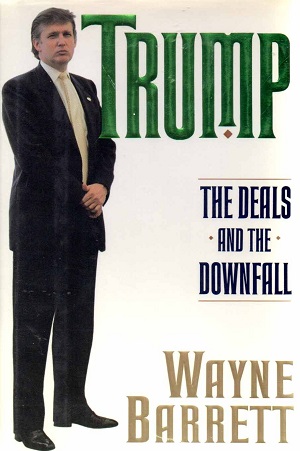
First edition of Wayne Barrett’s book, “Trump: The Deals and The Downfall,” was published by Harper Collins in 1992. Click for Amazon.
In 1992, Barrett published an investigative biography on Trump based on his years of reporting about him in The Village Voice. Published by Harper Collins, Trump: The Deals and the Downfall, is regarded as a meticulously researched investigative biography that examines the sordid history and financial machinations behind Trump’s “carefully polished patina of success,” focusing on his reliance on bank debt, relationships with questionable figures, and the financial, family, and personal struggles he faced in late-1970s-through-1980s New York.

Included among the book’s key revelations are detailed allegations that Trump was subject to a bribery investigation in 1979 and a racketeering investigation two years later, stemming from his involvement in New York city construction projects. The book also covered Trump’s involvements and financial difficulties with his Atlantic City casinos.

During the period covered in Barrett’s book, Trump was beset by a string of bankruptcies, a scandal-plagued public divorce, and a forced retreat from public view – which accounts for “the downfall” part of Barrett’s book. Interestingly, as the book was being prepared for publication, Trump found out about it, and called Barrett seeking, unsuccessfully, to have “the downfall” part of the title removed. While Trump did have his difficulties in those years, his fall from prominence would prove temporary and would not deter his more ruinous terms as President.

Village Voice reporter, Wayne Barrett, in later years.
Praise for the book came from James B. Stewart, Pulitzer Prize-winning author of Den of Thieves. He called Barrett’s book a “withering portrait of the most self-mythologized and promoted businessman of our era, an exhaustively researched and long-overdue antidote to Trump’s own books. It is a penetrating portrait of the age that spawned him and the many who aided and abetted his rise….[D]estined to be the definitive account….”

However, Barrett’s 1992 book on Trump did not do well, in large part because it came at a time when interest in Trump’s rising star had collapsed along with his business failures and debt problems. The book was also not reviewed by the New York Times, for example, and became something of a flop. But there were other venues — including a January 1992 radio interview with Barrett by Terri Gross on her NPR / “Fresh Air” program — that highlighted what Barrett had learned about Trump in the book. And the years would eventually turn in Barrett’s favor. His research, and his 1992 book all had something of a second coming when Donald Trump began to set his sights on the White House in 2015-2016. Barrett and book then began to be recognized by reporters as a primary source, while Barrett’s Brooklyn home became something of a “mecca” for journalists now focusing on Trump, visiting with Barrett and his voluminous Trump files and documents.


2016 Edition

In fact, Barrett’s 1992 book would rise Phoenix-like from the ashes of the 1990s, given Trump’s improbable political ascent nearly 25 years later. The book was republished, expanded, and retitled as: Trump: The Greatest Show on Earth: The Deals, The Downfall, The Reinvention. The “new and improved” Barrett book — appearing in mid-2016 ahead of that fall’s presidential election — would be regarded as “a rich and layered…excavation of the dirty-dealing, insiderism, and blind greed that made Trump a powerful figure in 1980s New York.”

Amazon’s description of the re-issued book in 2016 — with a new and scorching introduction by Barrett — noted the following:
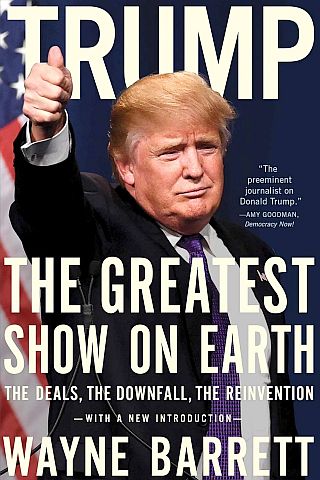
Wayne Barrett’s 1992 book was republished in 2016 as Trump began his run for the White House, in an expanded edition with new introduction and re-titled, “Trump: The Greatest Show on Earth: The Deals, The Downfall, The Reinvention.”  Click for Amazon.
Wayne Barrett’s 1992 book was republished in 2016 as Trump began his run for the White House, in an expanded edition with new introduction and re-titled, “Trump: The Greatest Show on Earth: The Deals, The Downfall, The Reinvention.” Click for Amazon.

Donald Trump claims that his success as a “self-made” businessman and real estate developer proves that he will make an effective president, but this devastating investigative account by legendary reporter Wayne Barrett proves otherwise. Back in print for the first time in years, Barrett’s seminal book reveals how Trump put together the biggest deal of his life—Trump Tower—through manipulation and deceit; how he worked with questionable characters from the mafia and city politics; and how it all nearly came crashing down. Here is a vivid and inglorious portrait of the man who wants now to be the most powerful man in the world.

In Trump: The Greatest Show in the World—The Deals, the Downfall, the Reinvention, Barrett unravels the myth and reveals the truth behind the mogul’s wheelings and dealings. After decades covering him, few reporters know Trump as Barrett does. Instead of the canny businessman that Trump claims in his own books, Barrett explores how Trump exploited his father’s banking and political connections to finance and grease his first major deals. Barrett’s investigative biography takes us from the days of Donald’s lonely youth to his brash entry into the real estate market, and to the back room deals behind his New York, Atlantic City and Florida projects.

Jennifer Gonnerman, writing in The New Yorker just after the 2016 election, noted: “There may be no journalist in the nation who knows more about Trump than Barrett.” Timothy O’Brien, who was a research assistant to Barrett on the 1992 Trump book – and who later wrote his own book, TrumpNation – called Barrett’s work on Trump “foundational.” Barrett, he said, “took Trump seriously long before anyone else did, and most of the work that followed Wayne’s was built upon his insights.”

In a new foreword to his re-issued Trump book, Barrett himself – ever the excoriating journalist – criticized the “cowardly silence” of the press on the role of race in the 2016 presidential campaign. “In a season of broadcast blunders, the worst was the race coverup, with vacuous analysts, especially on primary nights, going on and on about anything but race explaining the Trump tide,” Barrett wrote. He also had harsh criticism of TV news. “All of my life, I have believed and said, we’re in the truth-telling business. Our job is to tell truth,” he told CNN. “I can’t say that anymore about broadcast journalism.”


NY-PBS Interview

Trump, Race, Media
Wayne Barrett, 2016

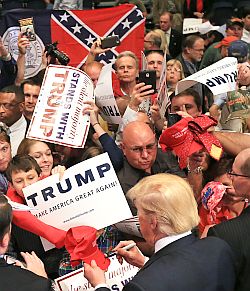
Donald Trump rally, 30 November 2015, Macon, GA.
In a May 2016 video interview with Matt Ryan, on New York Now PBS, Barrett held forth in more detail about his views on both the evolution of Republican Party racism and Trump’s more explicit use of it, plus the shortcomings Barrett then saw in broadcast journalism. These views were prompted near the end of the interview, with a question about Trump’s surprising rise in the 2016 Republican primaries, about to take the Republican nomination. Here’s that exchange:

Matt Ryan: …Certainly most people are surprised that [Trump is] so close to getting the GOP nomination. You’ve known him for decades and have followed him closely as anyone else. I mean, how surprised are you?

Wayne Barrett…Well, I never thought he’d go this far;.I don’t think he ever thought he would go this far. He and Roger Stone I think decided to do this thing, for some crazy reason…I don’t think either of them ever expected to be where they are today….And it’s a commentary on the state of the Republican Party more than it is a commentary on the state of the country…Barrett charged that the Republican Party, since the time of Lee Atwater, was built in part on a kind of naked racism, though covered up in subtler form – that is, until Trump came along and made it more explicit. You know, if you go [back] decades, since Lee Atwater, or before, you know building a party where part of it, at least, is rooted in naked racism. Then somebody, eventually, is going to come along and hit that nerve… I think these rallies that [Trump] has… It’s almost like – there’s an air of racial solidarity about it – that’s really what it’s speaking to in a way – that sometimes he’s pretty explicit about that. But even if he’s not being explicit about that, you feel in the air when you watch these things. This is “white boys talking to white boys,” you know. We already understand the real message here. And the party has done a good job of covering that up for a long time, of keeping a curtain on top of what was really become the White People ‘s Party of America. But Donald, has cut through all of that cloth, and making it much more explicit. And eventually, somebody was going to do that. And with his skills – which are pretty remarkable skills as a public personality – and with the aid of broadcast journalism…. I think print journalism has been okay, really, The coverage of him [Trump] in print has been okay.

Mattt Ryan: He’s dominated the cable new shows; there’s no question.

Television journalism, in Barrett’s view, was not doing its job; not airing the right stories. “It’s completely determined by the narrative they’re trying to sell.”Wayne Barrett: I’m talking about – you’re in the business…But the normal thing is if The New York Times runs an investigative piece – which they’ve done three or four excellent pieces on Donald – they at least get discussed on cable TV – but that doesn’t happen. Washington Post guys have done marvelous stuff; Politico, marvelous stuff. These are the major news organizations in the United States. They can’t get a minute of air time, these stories. You know, usually you get the reporter who wrote the story on the air. There’s a discussion; What does this mean? What does that mean? So, print is doing its job. I think that they can do a better job, but they’ve done a reasonable job. And television just won’t do what it’s supposed to do, what it does with every email story about Hillary [Clinton]– if there’s one line of news in it, it’s on the air all night.. But you know, it’s been remarkable how television journalism – I’ve always thought ratings was part of it. But I thought there was some journalistic accountability here. But there appears to be none. Its completely determined by the narrative they’re trying to sell.

Matt Ryan: Well, Wayne, Thank you for your time.


Politico’s Luncheon

In late spring 2016, Politico – the digital publisher known in the U.S. for its Politico website and magazine – hosted a roundtable discussion with five prominent biographers and journalists who had chronicled Donald Trump and family over decades, including: Wayne Barrett. Among the others attending were: Gwenda Blair, author, The Trumps: Three Generations That Built an Empire (2000); Michael D’Antonio, author, Never Enough: Donald Trump and the Pursuit of Success (2015); Harry Hurt III, author, Lost Tycoon: The Many Lives of Donald J. Trump (1993); and, Timothy O’Brien, author, TrumpNation: The Art of Being the Donald (2005).
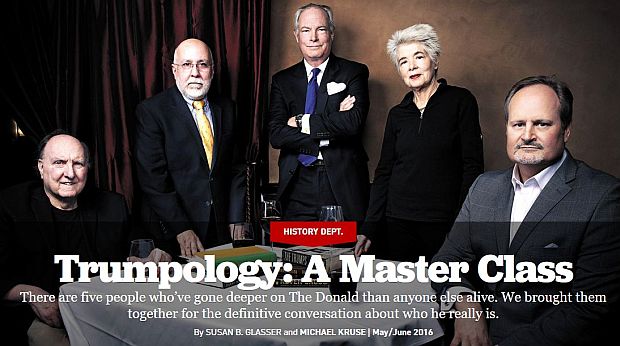
In its May/June 2016 edition, “Politico” magazine published its roundtable discussion with five writers who then had written extensively about Donald Trump and/or Trump family history – shown here from left to right: Wayne Barrett, Michael D'Antonio, Harry Hurt III, Gwenda Blair, and Timothy O'Brien. Click for the full story at Politico.

This group – plus Politico moderators Susan B. Glasser and Michael Kruse – gathered for lunch, appropriately, at the Trump Grill inside Trump Tower in Manhattan. Trump by then was wining primaries in his 2016 presidential bid, and there was rising interest on just who this guy was. The discussion of these journalists with Politico was later published in the May/June 2016 edition of Politico’s online magazine. In a brief introduction to their session with the five Trump authors and what transpired at their luncheon, Glasser and Kruse noted that: “…the conversation ranged from the emotional wounds that drive Trump to the roots of his demagoguery to his alleged ties to the mob. The rest of the media might still be struggling to explain Trump’s political rise, but these five writers saw his ambition—and ego—from the very early days. Here’s how Trump the candidate came to be.”

Each of these Trump authors – including Barrett – had interesting nuggets, insights, and revelations about their experiences with, and reporting about, Donald Trump – from his earliest days in New York, his relationships with his father, his branding, his TV and film conceptions of himself, and more, plus reaction to his then surprising rise as a presidential candidate. It’s a worthwhile interview to read, still relevant in 2026. Click on the photo above for the full Politico story and transcript.


Book on Barrett
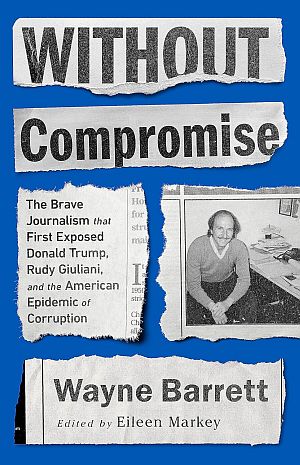
2020 book, “Without Compromise,” Eileen Markey, editor. Click for Amazon w/video.
In 2020, a separate book on Barrett’s work edited by Eileen Markey – Without Compromise: The Brave Journalism that First Exposed Donald Trump, Rudy Giuliani, and the American Epidemic of Corruption, was issued by Bold Type Books.

Without Compromise is a collection of groundbreaking investigations by Wayne Barrett, the first anthology of Barrett’s investigative work, It is accompanied by essays from colleagues and those he trained.. Inlcuding: Joe Conason, Kim Phillips-Fein, Errol Louis, Gerson Borrero,Tom Robbins,Tracie MacMillan, Peter Noel, Adam Fifield, Jarrett Murphy, Andrea Bernstein, Jennifer Gonnerman, and Mac Barrett.

As the Amazon entry on the book notes “In an age of lies, fog, and propaganda, when the profession of journalism is degraded by the White House and the industry is under financial threat, Barrett reminds us that facts, when clearly accumulated, are our best defense of democracy.”

A Salon.com description also adds:

A collection of groundbreaking investigations by Wayne Barrett … With piercing moral clarity and exacting rigor, Wayne Barrett tracked political corruption in the pages of The Village Voice fact by fact, document by document for 40 years. The first to report on the scams and crooked deals that fueled the rise of Donald Trump in 1979, Barrett went on to expose the shady dealings of small-time slum lords and powerful New York City politicians alike, from Ed Koch to Rudy Giuliani to Michael Bloomberg.

Jane Mayer, author of Dark Money, noted in her comment on the book about Barrett: “As Donald Trump rose to power no journalist busted him earlier or better than the late investigative reporter Wayne Barrett, whose indispensable work is gathered in Without Compromise.“…Barrett’s pieces provide an x-ray into Trump’s soul, and into the civic corruption that fueled his rise….”
++++++– Jane Meyer
Barrett’s pieces provide an x-ray into Trump’s soul, and into the civic corruption that fueled his rise. These stories are essential reading, alive with fresh insights and information illuminating today’s politics, and remind us that rigorous journalism is still democracy’s best defense.”

Trump predictably and true to form – according to one account by Politico’s Michael Kruse – used his typical arsenal of epithets over the years to disparage Barrett, calling him “a very bad writer,” “a second-rate writer” and “a jerk.” Trump also ranked Barrett as “one of the three worst journalists of all time,” a remark which Barrett took as “a great honor.” Reportedly, Barrett would say of this last Trump slur, seeing it as a mark of high praise – “I want it inscribed on my tombstone.”
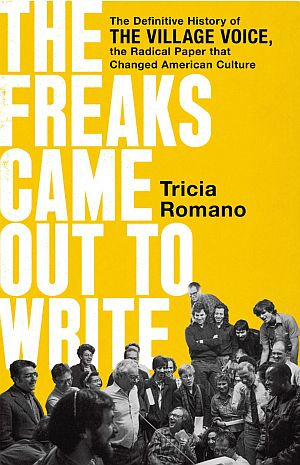
Tricia Romano, “The Freaks Came Out to Write: The Definitive History of the Village Voice, the Radical Paper That Changed American Culture,” 2024, Public Affairs Press, 608 pp, including sections on Wayne Barrett.  Click for Amazon.
Tricia Romano, “The Freaks Came Out to Write: The Definitive History of the Village Voice, the Radical Paper That Changed American Culture,” 2024, Public Affairs Press, 608 pp, including sections on Wayne Barrett. Click for Amazon.
But’s Barrett’s analyses of Trump and his deals only underscore his careful and thorough brand of truth-telling. And his findings remain among the more fulsome and troubling critiques of Trump’s calculating and loathsome ways, and will likely withstand the test of time.

Wayne Barrett died in Manhattan on January 19, 2017, from complications of interstitial lung disease and lung cancer. Coincidentally, Barrett died the day before Trump was inaugurated as president — but no doubt, observing from the hereafter of the resulting Trump wreckage since then to tell the rest of us – “told you so.”

More Trump. See also at this website, additional history on Donald Trump, including: “Trump on Film: A Partial Listing, 1990-2024,” covering some 30 Trump films. More magazine treatments of Trump at this website include:, “The Trump Dump: New York Magazine, 2016,” profiling a special issue of that magazine, and also, “Trump Send-Ups, Spy Magazine, 1980s-1990s,” reviewing Trump spoofs and satire in that magazine. Other stories at this website mentioning Trump include: “Political Science: Randy Newman Music,” regarding nuclear weapons; “I Won’t Back Down” about the use of Tom Petty song in political campaigns; and “Shields, Brooks, Trump,” regarding some press reaction to earlier Trump remarks in 2017.

Thanks for visiting – and if you like what you find here, please make a donation to help support the research, writing, and continued publication of this website. Thank you. – Jack Doyle

Please Support
this Website

Donate Now

Thank You

____________________________________

Date Posted: 27 October 2026
Last Update: 27 October 2026
Comments to: jackdoyle47@gmail.com

Article Citation:
Jack Doyle, “Barrett on Trump: Early Warnings,
1970s-2010s,” PopHistoryDig.com, October 27, 2026.

Twitter: JackDoyle/PopHistoryDig
BlueSky: jackdoyle.bsky.social

____________________________________


Trump-Era Books at Amazon.com…

M. Haberman & J. Swan, “Regime Change: Inside the Imperial Presi-dency of Donald Trump,” 2026, Simon & Schuster, 496pp. Click for Amazon.
Andrew Weissmann, “Liar's Kingdom: How to Stop Trump’s Deceit and Save America,,” 2026, Little, Brown & Co., 240 pp.  Click for Amazon.
Andrew Weissmann, “Liar's Kingdom: How to Stop Trump’s Deceit and Save America,,” 2026, Little, Brown & Co., 240 pp. Click for Amazon.
Charles J. Sykes’ book, “How the Right Lost Its Mind,” with George Will blurb on front cover, 2018 edition, Click for Amazon.


Sources, Links & Additional Information

Gwenda Blair, “The Trumps: Three Generations of Builders and a President,” 2001, Simon & Schuster, 592 pp. Click for Amazon.
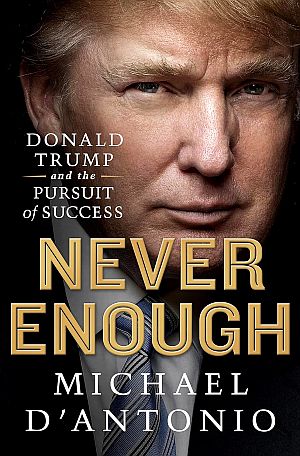
Michael D'Antonio’s 2015 book, “Never Enough: Donald Trump and the Pursuit of Success,” Thomas Dunne Books, 400 pp. Click for Amazon.
Kai Bird with Susan Goldmark, “American Scoundrel: Roy Cohn's Dark Journey From Joe McCarthy to Donald Trump,” 2026, Scriber, 528pp. Click for Amazon.
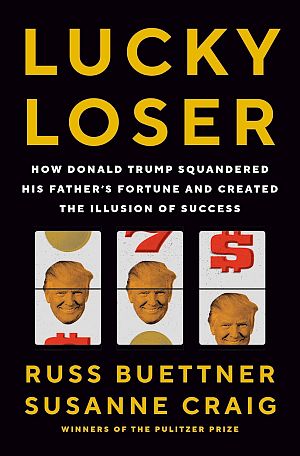
Russ Buettner & Susanne Craig, “Lucky Loser: How Donald Trump Squandered His Father's Fortune and Created the Illusion of Success,” 2024, Penguin Press, 528pp. Click for Amazon.
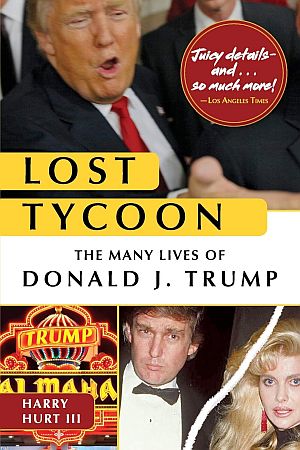
Harry Hurt III, “Lost Tycoon: The Many Lives of Donald J. Trump,”  2016, Echo Point Books & Media, 436pp.  Click for Amazon.
Harry Hurt III, “Lost Tycoon: The Many Lives of Donald J. Trump,” 2016, Echo Point Books & Media, 436pp. Click for Amazon.

“Wayne Barrett,” Wikipedia.org.

Wayne Barrett, “How a Young Donald Trump Forced His Way From Avenue Z to Manhattan,” The Village Voice, January 15, 1979.

Wayne Barrett, “Donald Trump Cuts the Cards: The Deals of a Young Power Broker,” The Village Voice, January 22, 1979.

Wayne Barrett, “The Dirty Deal That Helped Make Donald Trump [also titled, “A Seamless Web”]; How City and State Officials, Real Estate Operators, Lawyers, and Bankers Came Together in a Multimillion-dollar Deal to Rebuild the Commodore Hotel, Largely at Public Expense,” The Village Voice, February 26, 1979.

Wayne Barrett, “The Birthday Boy: Roy Cohn is 52 at 54; A Big Apple Rogue’s Gallery Turned out to Celebrate “The Man Who Symbolizes Evil to Many in this City’,” The village Voice, March 5, 1979.

Joe Conason, “Beware When ‘Three Big Fat Men’ From the Trump Organization Knock on Your Door; How Would Donald Trump Feel If Some Corporation Evicted His Ill and Aging Parent, Without Notice or Compassion, Removing All Possessions to Some Unknown Location?,” The Village Voice, May 5, 1980.

Wayne Barrett. “Will Trump Get Casbah Giveaway?,” The Village Voice, April 7, 1981.

Wayne Barrett, “Donald Trump: Demolishing Affirmative Action,” The Village Voice, July 29, 1981.

Michael Sorkin, “Dump the Trump; The Centerpiece of the Scheme, the 150-Story Erection, Is Trump’s Third Go at the ‘World’s Tallest Building.’ … Was Ever a Man More Preoccupied with Getting it up in Public?,” The Village Voice, December 24, 1985.

Wayne Barrett, David Swanson, “Donald Trump’s Tower of Trouble; Meet the Medicaid Cheats, Coke Dealers, Mobsters — and Those Who May Have Gotten a Touch Too Friendly with Mobsters — Who Call Trump Tower Home,” The Village Voice, December 17, 1991.

Wayne Barrett, “How Donald Trump Managed To Turn Triumph Into Disaster; When Donald Trump Dumped on Ed Koch, He Doomed His Own Greatest Project. In This Tale of Two Egos, Trump Makes the Biggest Mistake of His Career and Hastens His Demise,” The Village Voice, December 17, 1991.

Wayne Barrett, “Donald Trump’s Political Football; How Donald Trump Sacked the Cuomo Team and Turned the State’s Losses — Including Two Football Teams and Hopes for a New Stadium — Into Personal Gain,” The Village Voice, January 14, 1992.

Wayne Barrett, “Donald Trump’s Seduction of Mario Cuomo; Trump Surrounded Himself with the Governor’s Lawyers, Aides, Son — Even His Bodyguard —To Get New York’s Top Pol on His Side,” The Village Voice, January 14, 1992.

Adam Weinstein, “If You Dig Political Muckraking, Thank Wayne Barrett,” Mother Jones.com, January 5, 2011.

Richard Pérez-Peña, “The (Ex) Voice of the Village,” New York Times, February 25, 2011.

Karen Tumulty and Nia-Malika Henderson, “Donald Trump Says He Won’t Run for President in 2012,” Washington Post, May 16, 2011.

Wayne Barrett, “Inside Donald Trump’s Empire: Why He Didn’t Run for President in 2012,” The Daily Beast, May 26, 2011.

Gail Ablow, “The Trump Files, Part One: Investigative Reporters Have Been Digging into the Candidate’s Business Dealings from the past and Present. Here’s Our Roundup Just in Time for the Weekend.” Bill Moyers.com, February 26, 2016.

Gail Ablow, “The Trump Files, Part Two: Our Trump Files Are Expanding. Readers Have Sent in Additional Pieces and New Investigations Are Unfolding. Here’s Our Latest Lineup of Recommended Reading,” BillMoyers.com, March 16, 2016.

Matt Ryan, “Wayne Barrett Reflects on His Decades Covering Donald Trump,” NYnow.wmht.org (NY PBS) May 3, 2016 (video interview with Barrett begins about half-way in, at 12:00 minute mark following New York Now TV segment, WMLT, Troy, NY).

Susan B. Glasser and Michael Kruse, “Trumpology: A Master Class: There Are Five People Who’ve Gone Deeper on the Donald than Anyone Else Alive. We Brought Them Together for the Definitive Conversation about Who He Really is,” Politico.com, May/June 2016.

Wayne Barrett, “Donald Trump’s Billionaire-Backed Super-PAC Also Paying Rudy Giuliani’s Law Firms,” The Daily Beast, November 5, 2016.

Jennifer Gonnerman, “Wayne Barrett, Who Wrote the Book on Trump, Is Still Reporting,” The New Yorker, November 10, 2016.

Alex Shephard & Theodore Ross, “There’s No Check on Trump Except Reality: A Q&A With Wayne Barrett. The Veteran New York Journalist Dishes on Trump, Giuliani, and More,” NewRepublic.com, December 1, 2016.

Sam Roberts, “Wayne Barrett, Fierce Muckraker at The Village Voice, Dies at 71,” New York Times, January 19, 2017.

Michael Kruse, “The Muckraker Who Tormented Trump; Wayne Barrett Died the Day Before the Inauguration of a Man Whose Rise He Labored for Decades to Prevent,” Politico.com, January 20, 2017.

Adam Weinstein, “Wayne Barrett Exposed the Real Trump. Now There’s Only One Way to Honor Him;.Remembering the Legendary Village Voice Reporter Who Launched an Army of Muckrakers,” MotherJones.com, January 21, 2017.

Tom Robbins, “Wayne Barrett: A Brilliant New York Beacon and Political Warrior for Justice,” The Village Voice, January 24, 2017.

“An Incomplete Timeline of Donald J. Trump and His Associates’ Pillaging of the United States of America,” Dumplord.com, (includes a wide ranging and somewhat rambling collection of various dates, news stories, etc. on Donald Trump and his father, and Trump associates, 1930s to 2020).

Tricia Romano, “A Brief Oral History of Wayne Barrett, the First Journalist to Doggedly Cover Donald Trump,” Vanity Fair.com, February 12, 2024.


Barrett & Muckrakers at Amazon.com…

Newfield & Barrett, “City For Sale: Ed Koch and The Betrayal of New York,” 1988, HarperCollins, 466 pp. Click for Amazon.
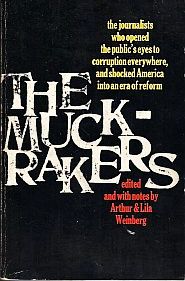
Arthur & Lila Weinberg, “The Muckrakers”- Journalists Exposing Corruption, 1902-1912, Putnam, 1964. Click for Amazon.
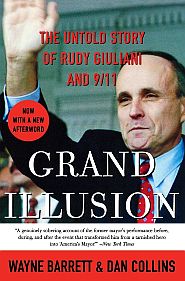
Wayne Barrett, Dan Collins, “Grand Illusion: The Untold Story of Rudy Giuliani & 9/11,” 2007, Harper Collins, 402pp. Click for Amazon.

“Murdoch’s NY Deals”
1976-1977

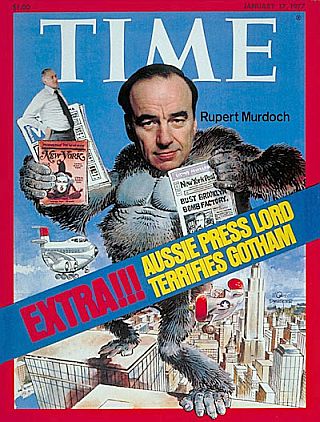
Jan 17, 1977: Rupert Murdoch depicted on Time magazine cover as the invading King Kong of New York publishing world, with Time’s editors offering a Murdoch-esque news banner. Click for copy.
     In was mid-January 1977, and Jimmy Carter was about to be sworn in as President of the United States.  But in the newspaper and magazine business, the big news of the day was an audacious New York media grab by a then little-known Australian newspaper mogul named Rupert Murdoch.

By late January 1977, Murdoch would own two premier New York media companies: the New York Post newspaper and New York Magazine Co., which then published three magazines: New York, The Village Voice, and New West.

     Rupert Murdoch in the 1970s was just getting started on his global media empire, and by today’s standards, his 1976-77 New York acquisitions seem tame. Yet these deals, and the changes Murdoch undertook with them at the time, shook things up in the media print world and hinted at his grander plans ahead.

In later years, Murdoch would create the Fox television network and acquire the Wall Street Journal, among other properties. His 1976-77 deals, though, were the first signs that Murdoch would be a determined player in the U.S. market. 

These New York deals, however, were not the first Murdoch had made in America.

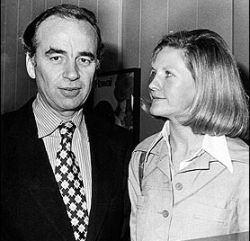
Murdoch and wife Anna in Texas, 1973.
     In 1973 he acquired two newspapers in Texas — The San Antonio Express and The San Antonio News — for $18 million.  The following year, he entered the U.S. supermarket tabloid business launching a brand new paper then called The National Star.  More on these later.

     By 1976, however, Murdoch had set his sights on the bigger eastern cities.  He had looked at the possibility of acquiring some major women’s magazines, such as Redbook and Ladies’ Home Journal.  But he was also considering starting a daily paper in either New York City or Boston, and that’s when the New York Post became available.

     The New York Post had roots that dated to 1801, and one of its founders was Alexander Hamilton. For years it was known as the New York Evening Post, and described itself as the nation’s oldest, continuously-published daily newspaper.


The New York Post

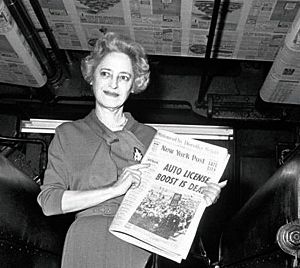
Dorothy Schiff, the publisher of The New York Post, with the presses running overhead in 1963.
At the time Murdoch became interested in the New York Post it was owned by Dorothy Schiff, the granddaughter of Jacob H. Schiff, a New York city financier and social welfare advocate.  Dorothy Schiff had purchased the paper in 1939.  Under her tenure the New York Post was devoted to liberalism, supporting trade unions and social welfare.  It was the only New York City daily to support Adlai Stevenson, the Democratic candidate for president, in 1952 and 1956.  Among some of its popular columnists were: Drew Pearson, Eleanor Roosevelt, Max Lerner, Murray Kempton, Pete Hamill, Earl Wilson and Eric Sevareid.  It also had well a respected theater critic and Broadway columnist.  Under Schiff’s direction, the paper increased its circulation by two thirds.  The Post had undertaken stories critical of New York master builder Robert Moses, “slum clearance,” and J. Edgar Hoover, among others.  It is also known for its 17-part series on communist witch-hunter, U.S. Senator Joseph McCarthy —  headlined, “Smear, Inc.: Joe McCarthy’s One-Man Mob.”  By 1976, The New York Post was the only surviving afternoon daily in New York City, with a circulation of about 500,000.

     When Murdoch remarked to Schiff at one meeting that he was thinking about launching a new paper in Boston or New York, Schiff, then 73, told him she was thinking of selling the Post.  According to one account of the deal that followed, “Murdoch pounced, wrapping up the $30 million sale in three weeks of secret negotiations.”  He acquired the paper by late November 1976.


Dec 20, 1971.
Dec 20, 1971.
Apr 22, 1974.
Apr 22, 1974.
Mar 17, 1975.
Mar 17, 1975.
Aug 23, 1976.
Aug 23, 1976.

New York Magazine Co.

     After Murdoch made the Post deal, he moved next on the New York Magazine Co.  This company was run by Clay Felker, an innovative editor and writer who had worked at various newspapers and magazines including Life, Sports Illustrated, Time, Esquire, and The New York Herald Tribune.

     The flagship publication of the New York Magazine Co. was New York magazine, a weekly focused on culture, politics, and New York City style.  New York magazine was begun in 1964 by Felker as a Sunday supplement enclosed with The New York Herald Tribune.  After the Tribune folded in 1968, Felker and graphic designer Milton Glaser (who later invented the “I Love NY” logo) reintroduced New York as a glossy, stand-alone magazine.

     New York initially was intended to compete with The New Yorker  — and an earlier, scathing piece about the New Yorker’s “mumified” reporting in April 1965 when New York was still a Tribune supplement, had already set off a war between the two.

But New York magazine also became known for its own unique enterprise: helping launch and define what would be called the “new journalism” — a departure from the more objective norm of journalism to a form of narrative and point-of-view journalism relying on characters, dialogue, participant authors, and/or fictional devices.

Clay Felker in 1976 at ‘The Village Voice.’
     Felker was the visionary in the enterprise. The magazine, under his leadership, “set about revising the hierarchies of urban experience,” Sarah Bernard and Aaron Latham would write in a 2008 retrospective on New York magazine, continuing:

“Felker had observed something new happening in the city, and he’d brought his own outsider’s sense of romance and a fascination with power and status. The magazine he made had a new palette of interests, with no brow distinctions. Restaurants were as important as business, or politics. Everything that went on in a city dweller’s mind was something to be curious about.”

 
The magazine, with Milt Glaser’s help, also did clever things with design, text, and illustration, also departing from the norm. New York magazine would become a model for many city and other magazines that would follow it in years to come.

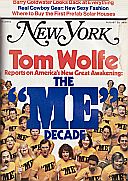
New York’s writers, editors, and contributors were some of the most talented to come out of the late 1960s and 1970s, including: Tom Wolfe, Jimmy Breslin, Nora Ephron, Kurt Andersen, Gloria Steinem, Gail Sheey, John Heilemann, Nick Cohn, Ken Auletta, Richard Reeves, Aaron Latham, Dick Schaap, Michael Kramer, John Simon, Pete Hamill, Gael Greene, Walter Bernard, Bill Flanagan, Anna Wintour, James Brady, Lally Weymouth, Andy Tobias, Judy Daniels, Laurie Jones, Nancy Newhouse, Nick Pileggi, Mark Jacobson, Robert Benton, Byron Dobell, Mimi Sheraton, Gael Greene, Dorothy Seiberling, Amanda Urban, Walter Bernard, and others. 

But Clay Felker was the visionary leader and editorial maestro. As Tom Wolfe would put it, “he created the hottest magazine in America in the second half of the twentieth century: New York.”

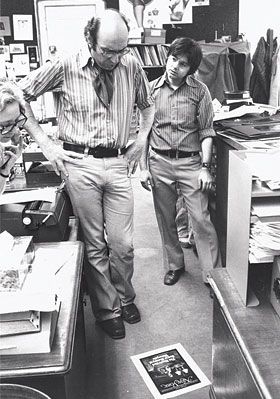
Milt Glaser & Walter Bernard at New York magazine offices pondering a cover design,  1974. (Photo: Cosmos Sarchiapone).
Milt Glaser & Walter Bernard at New York magazine offices pondering a cover design, 1974. (Photo: Cosmos Sarchiapone).
     New York in the 1960s and 1970s under Felker and Glaser covered the national topics of the day as well as New York’s cultural scene and its movers and shakers.

Tom Wolfe, wrote one of the magazine’s early features on 1960s’ psychedelic cultural renegade Ken Kesey and his band of pranksters, a story that later became the Wolfe novel, The Electric Kool-Aid Acid Test. 

Gloria Steinem wrote about women’s issues for New York.  She also wrote on the 1968 presidential election.  Felker helped her launch her own publication in 1971, MS magazine, using New York to launch a sample insert issue (see cover above). 

New York also covered New York sports stars, the arts, and national politics. In 1969, it did a story on Joe Namath, flamboyant quarterback of the New York Jets. In the 1970s, Richard Nixon and the Watergate scandal were covered closely. 

In 1976, Nick Cohn wrote a New York story titled, “Tribal Rites of the New Saturday Night,” an account of a young working-class Brooklyn guy who spent his evenings at a local disco club — a story that became a sensation and helped spawn the film Saturday Night Fever.

     The New York Magazine Co. also owned two other publications — The Village Voice and New West.  The Village Voice, originally established by writer Norman Mailer and others in October 1955, was merged with Felker’s company in 1974, continuing as The Village Voice.  The newest member of the New York Magazine group by 1977 was New West, which Felker had launched in Los Angeles, California in 1976, modeled after New York.  The circulation of each of the magazines at the time of Murdoch’s takeover in 1977 was as follows: New York, 375,000; the Village Voice, 162,000; and New West, 290,000.  So, how did Rupert Murdoch come to own this company?


Murdoch vs. Felker

Rupert Murdoch & Clay Felker in East Hampton, NY in the 1970s, when the two newspapermen were “pals.”
     Clay Felker had met Rupert Murdoch in the early 1970s at the home of Washington Post Chairman, Katharine Graham.  Felker, by this time had established his reputation as an innovator, and a gifted though somewhat erratic editor.  He and Murdoch got on well at first, and by some accounts became “great pals.”  In fact, Felker had introduced Murdoch to New York Post publisher Dorothy Schiff in 1974, at Felker’s East Hampton beach house.  The two newspaper men had explored the possibility of undertaking a few business ventures together.  Felker also confided in Murdoch about some difficulties he was having with his board of directors, as there had been some feuding about Felker’s “high living and low profits,” as one report later put it.  Felker wanted to be chairman of the New York Magazine Co., but his board denied him that post — as well as his demand for a salary increase and company purchase of his Manhattan duplex.  Felker had exceeded his budget for the launch of New West, and was reported as having spent lavishly on visiting staff, office space, and cut-rate introductory subscriptions.  Meanwhile, the New York Magazine Co. was a publicly-held company, and its stock in 1976 was not appreciating, as the company had suffered a loss.

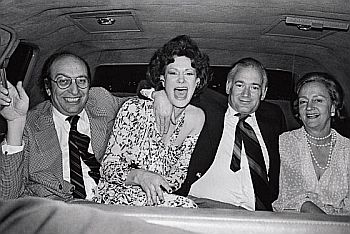
Milton Glaser, Lally Weymouth, Clay Felker, and Katharine Graham in 1976. (Photo: Jill Krementz)
     Felker, then looking for some allies on his board, had asked Murdoch if he would be interested in buying a stake in the company. Some of Felker’s board members weren’t always cooperative and a few held sizeable stakes in the company. When Felker acquired the Village Voice in 1974, Carter Burden, the former owner of the Voice, received about 24 percent of the New York Magazine Co. stock.  Murdoch told Felker he would be happy buy into the New York Magazine Co., but he wanted control of the company, which Felker would not agree to.  The strategy of enlisting Murdoch’s help was soon dropped by Felker — but not Murdoch.

     Murdoch saw another publishing asset to add to his New York base and began negotiating directly with the top shareholders at the New York Magazine Co.  He wanted the whole company.  Felker then sought allies in defense of Murdoch’s moves, eventually enlisting Katharine Graham of the Washington Post, who agreed to match Murdoch bid for bid — starting at $7 a share, then $7.50, then $8.25, matching his offers.  But Murdoch by January 1, 1977 made a direct deal with Carter Burden, who then held the largest chunk of the company.  Murdoch also lined up more than a dozen other shareholders in the New York Magazine Co. and soon held over 50 percent of the company.  In the end, Murdock paid something on the order of $7.6 million for the New York Magazine Company.

Clay Felker addressing the troops at the Village Voice amidst Rupert Murdoch takeover in 1977. (Photo: James Hamilton).
     Felker had tried a variety of strategies to stop Murdoch, and at one point did get a temporary injunction from U.S. District Court judge to block some stock sales to Murdoch.  Felker had also lined up potential allies for cash, including British industrialist Sir James Goldsmith, Cincinnati financier Carl Lindner, and some unidentified New York real estate interests.  But the prospect of a protracted court battle with Murdoch soon dissuaded these backers.  In the battle with Murdoch, Felker also had the support of his New York staff, who were not keen on the idea of working for Murdoch.  They held press conferences and walked out at one point, some complaining that Murdoch would bring “trash” journalism to the enterprise.  They also met with Murdoch’s lawyers, arguing if they left, the enterprise would be devalued.  They were told in reply, according to Ken Auletta, that it didn’t matter what they thought or did, as writers they were merely “furniture” in the equation.

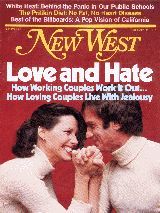
“New West” magazine, had a look & tone much like “New York,” but it also helped to put the company in jeopardy.
     On the inside of the New York Magazine Co., however, there was a perspective that Felker had made the company vulnerable with the New West project, enabling Murdoch to make his deal.  Here’s one observation from Alan Patricof, an early board chairman at New York:

“…He [Felker] always wanted to be respected as a businessman.  Then he wanted to start New West.  We didn’t have the money to do it.  Clay was determined to do it.  We reluctantly supported him.  Clay spent freely, and he really wanted to create this footprint on both sides of the country.  I remember going to Clay in ’76 saying, “Clay, we’re going to have to find some way of resolving this” — but he didn’t do much about it.  Then Rupert Murdoch came along and was prepared to pay a premium on the price at the time.  He knew that he was going to be buying something where Clay was not happy about it, and it wasn’t until the very last second, when the board had gone very far with Rupert, very far, at the midnight hour, that Clay produced Katharine Graham, but it was too late by then.  He had plenty of time, but he didn’t want to face up to it.  I have to tell you, it was one of the most reluctant sales I ever made…”

“…It was a time that we all thought the power was really with the writers, with the creative people, and in a way we learned what they learned in Holly-wood:  That’s not the way it is.  The power is with the money…”
                     – Richard Reeves
     In the end, Murdoch won.  Felker was not happy with the loss of his dream enterprise.  At the first directors’ meeting following the deal, Murdoch demanded two seats on the New York Magazine Co. board — and got them.  He also said to Felker at the time that he thought Felker was “an editorial genius” and wanted him to stay and run the magazine.  Felker refused.  In his departure from the company, Felker was paid $1.5 million for his shares plus his $120,000 salary for three years.  The managing editors of New York, the Voice and New West, as well as the ten most senior New York writers, were all given two-year contracts by Murdoch.  Clay Felker, meanwhile, went on to other magazines and editorial projects, briefly tried Hollywood, and later took a faculty position at the University of California at Berkeley.  In 1995 he was honored with the creation of the Felker Magazine Center at Berkeley.  After battling throat cancer for some years, he passed away in July 2008 at age 82 and was eulogized and fondly remembered by many of his former New York staff. 

     Richard Reeves, one of the early writers at New York, offered this observation on Felker, Murdoch, and the magazine changing hands in1977:

“…The story was Clay was a great editor and a bad businessman, and Murdoch sensed that.  He was like a wolf or a shark.  He could sense there was blood in the water, and he made his move.  It was a time that we all thought the power was really with the writers, with the creative people, and in a way we learned what they learned in Hollywood:  That’s not the way it is.  The power is with the money.  While we wrote about that all the time, and while Clay understood that intellectually, as a businessman I don’t think that he did.”


Measuring Murdoch

     Now that Murdoch owned New York, The Village Voice, and the New York Post, the city’s publishing establishment began to size up their new neighbor and the kind of journalism he might be bringing their way.  They looked at his record in Australia and the U.K, and what he had done in San Antonio and with his new national U.S. tabloid, The Star.  What they found was not encouraging.

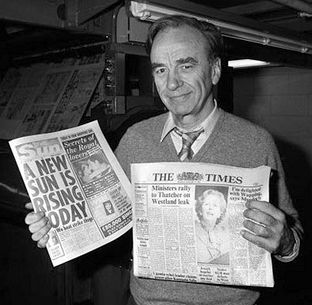
Rupert Murdoch shown with copies of his London newspapers “The Sun” and “The Times,” the latter of which he would acquire in 1981.
     Rupert Murdoch, born into an Australian newspaper family in 1931, was educated at Oxford in England and began his rise back home with one newspaper, the Adelaide News.  But he soon began acquiring suburban and provincial newspapers throughout Australia.  In 1956 he bought a Sunday paper in Perth for $400,000.  He was also successful launching the Channel Nine TV station begun in Adelaide, a station that became profitable.  In 1960, he spent $4 million for the Sydney Daily Mirror, a tabloid-styled paper.  He also acquired a small, Sydney-based recording company, Festival Records.  In 1964, he ventured to New Zealand acquiring a daily in Wellington called The Dominion.  That same year back home, he established a new newspaper called The Australian, the nation’s first national daily newspaper.  The Australian was intended by Murdoch to be a “quality” newspaper, and one with political influence.

     By 1968 Murdoch’s holdings included newspapers, magazines and broadcasting stations worth an estimated $50 million.  He then turned to the U.K., making a bid in 1969 for the largest-selling British Sunday newspaper, The News of the World. With $20 million he outbid British book publisher Robert Maxwell and won controlling interest of the “Sunday scandal sheet,” as some called it.  News of the World then had a circulation of about 6 million.  A year later, also in London, he acquired The Sun, a daily broadsheet newspaper associated with Labor politics; a paper then in poor condition with a circulation of about 950,000.  The Sun had begun in 1964 with noble aspirations, designed to tap into the lifestyle changes of the 1960s and the rise of the young, upwardly-mobile professionals, including career-oriented women.  Murdock and his editors turned it into a tabloid, shifted the emphasis away from Labor politics, and moved to more titillating topics using a formula of “sex, sport and sensation.”

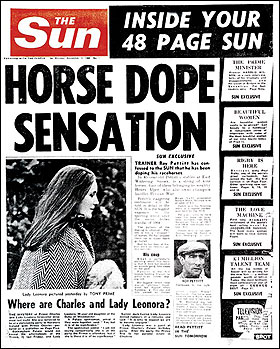
First edition of The Sun (U.K.) under Rupert Murdoch, Monday, Nov 17, 1969.
     The Sun’s first edition of November 17, 1969 ran with the front-page headline “Horse Dope Sensation,” billed as an “exclusive” — a story about a racing trainer admitting he had doped his horses.  Some of the stories inside that edition featured gossip on the “playboy Prince of Wales” — the 21-year-old Charles “sowing his wild oats” with 20-year-old daughter of the Duke of Westminster.  The Rolling Stones were also given some ink in the center of that edition, focused partly on the clothed and unclothed ladies they encountered in their rock ‘n roll travels.  Other stories in subsequent issues would focus on sex scandals.  At one point, Murdoch’s other London paper, The News of the World, began rehashing the memoirs of a famous call girl named Christine Keeler — a former model and showgirl whose affair with a British government minister in 1963 rocked the Conservative government of Harold Macmillan.  U.K. talk show host David Frost brought Murdoch on TV at one point to grill him about the Keeler material his paper was then running.  Some critics began calling Murdoch the “dirty digger” — digger being a slang term for an Australian.  Murdoch seemed unscathed by the criticism, happy to see his newspapers’ circulation rising.  In fact, the use of titillating material in Murdoch’s papers was just getting started.


“Page Three Girls”

     In November 1970 — about a year after The Sun’s first edition — a nude photo of German model Stephanie Rahn appeared on page three of The Sun.  It was the first nude photo, shot from the side with breast area exposed, that a major circulation U.K. newspaper had run.  Murdoch, out of the country when the photo ran, was reportedly upset over the move at first, but after the circulation numbers rose, accepted it.  Page Three girls boosted circulation — from about 1 million in 1969 to 3.8 million in 1977 by one count — and made The Sun one of the most popular newspapers in the U.K.Thereafter, “the Page Three girl” became a regular feature.  A year earlier, Murdoch’s first edition of The Sun had included a “glamour page” using clothed models, some with unbuttoned shirts or in otherwise provocative poses, but none that were nude or topless.  With the Stephanie Rahn photo of November 1970, however, a new era had begun, as the Page Three girls were gradually shown in more overtly topless and/or suggestive poses.  Over the next four years The Sun published photos of topless Page Three girls intermittently, going daily with the feature in 1975.  Although controversy ensued, the Page Three girls boosted circulation — from about 1 million in 1969 to 3.8 million in 1977 by one count — and made The Sun one of the most popular newspapers in the U.K.  Competing U.K. tabloids the Daily Mirror and Daily Star, instituted similar features in their papers.  Today, “Page Three” and “Page 3” are registered trademarks of News International Ltd, the parent company of The Sun.  In 1999, The Sun also launched a Page Three website, Page3.com, complete with online archive.

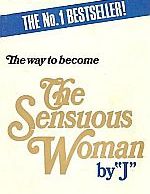
Excerpts from this book ran in The Sun. Click for book.
     The Sun newspaper in the 1970s also ran feature stories with headlines such as, “Do Men Still Want To Marry A Virgin?” and “The Way into a Woman’s Bed.”  The Sun would also run serializations of best-selling erotic books.  Portions of The Sensuous Woman by “J” (Joan Garrity), first published in 1969, were run in Murdoch’s Sun at a time when copies of the book were being seized by British customs, causing a stir in London, but providing some free publicity for Murdoch’s newspaper.

     The Sun also ran excerpts from Jacqueline Suzann’s 1969 novel, The Love Machine.  Through the 1970s, The Sun would overtake the Daily Mirror to become the UK’s biggest selling daily.  Back in Australia, meanwhile, Murdoch in 1972 acquired another Sydney newspaper, The Daily Telegraph, a morning tabloid.  But he also began looking elsewhere around the world.


Murdoch in Texas

     By 1973, Murdoch had turned his attention to America, buying up his first two newspapers in San Antonio, Texas — the San Antonio Express and San Antonio Evening News from the Harte-Hanks news group.  Reportedly, Murdoch flew into town and made the deal in a single day, signing the papers at the airport, but leaving instructions on his way out to turn one of the papers “into a screamer.”

Rupert Murdoch with wife Anna and Robert G. Marbut, of Harte-Hanks Newspapers in San Antonio, 1973 (photo: San Antonio Express-News).
     Under Murdoch, the San Antonio News became a tabloid-styled paper, while the San Antonio Express retained its original, conservative format.  Neither the San Antonio Express nor the Evening News showed much interest in politics.  Neither paper’s reporters covered state or national political conventions, but sportswriters would travel wide and far to cover the San Antonio Spurs basketball team.  Murdoch pitted his San Antonio News against Hearst’s San Antonio Light in a circulation battle which brought out the worst in both.  “Murdoch provided a daily diet of rape and mayhem, tortured tots, and killer bees,” reported Time magazine of Murdoch’s 1970s San Antonio paper.  One classic story in the San Antonio News during that time was about a divorced epileptic, who told police she was buried alive in a bathtub full of wet cement and later hanged upside down in the nude, with the News recounting a bizarre horror story of rape, torture, and starvation.

An example of San Antonio News “rack-card” advertising, 1970s.
     In addition, because single-copy sales were a major part of the News‘ circulation, news-stand “rack card” advertising became part of the hype.  Rack cards are poster-size advertisements attached to the paper’s vending machines and newspaper racks.  These cards often feature attention-grabbing headlines touting stories in the paper.  San Antonio News rack-card advertising went the extra mile, shouting out the newspaper’s latest story lines, using bizarre and sordid-type headlines such as: “Midget Robs Undertaker at Midnight”; “Dissolve Old Man in Acid!”; “Gunned-Down Pregnant Cat Fights for Life”; “Vampire Killer Stalks City”; “Sewer Boy Still Missing”; and “Animal Auschwitz.”  And the actual front-page headlines that appeared in the paper were often of a similar vein. In 1976, Texas Monthly magazine ran an article critical of Murdoch’s San Antonio News, titled, “Weirdo Paper Plagues S.A.”  In the piece, the writer took the paper to task for its diet of strange stories:

“…Readers of the News are learning things that five years ago they never dreamed they might be privileged to know: ‘Nude Principal Dead in Motel,’ for example, or ‘Armies of Insects Marching on S.A.’.  The front pages regularly impart disconcerting information:  ‘Handless Body Found.’  Or, ‘Screaming Mom Slain.’  Or, ‘Uncle Tortures Tots with Hot Fork.’ …The columns of the paper are populated by an unforgettable (and recyclable) cast of characters: tots, oldsters, thugs, nudies, grannies, moms.”

     Time magazine, in one January 1977 review of Murdoch’s San Antonio paper, observed that “the front page of the News is virtually devoid of substantial news.”  Only “the diligent reader,” concluded Time, would discover any meaningful reporting on politics or national policy issues.


The Star

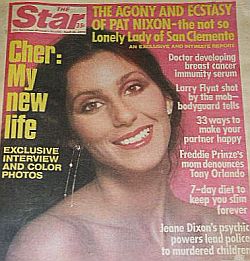
An April 1978 edition of “The Star” then featuring Cher and assorted other stories.
     Murdoch in 1974 also started from scratch a new tabloid he named The National Star.  It was designed as a U.S. supermarket paper to compete with the established National Enquirer tabloid.  The Star, as it would become known, was initially an unstapled tabloid printed on newsprint.  In a few years’ time, however, it became hugely successful, although at first it ran well behind the Enquirer.  Murdoch spent millions on a TV ad campaign to promote it and he burned through a series of editors as well.  But by 1977, The Star was making a profit and reaching about 1.6 million readers weekly.  By the early 1980s, it was almost even with the Enquirer, at close to 4 million.  Although based in New York, some portion of The Star’s production was printed on Murdoch’s San Antonio, Texas presses, and a version of The Star was also inserted as a Sunday supplement in the San Antonio papers.  Both The Star and The Enquirer did their commerce in front-page titillation, typically using the most current celebrity news coupled with headlines of the off-beat, outrageous, and/or scandalous.  Murdoch, meanwhile, had begun living in the U.S. by 1974, splitting his time between his New York city office and a more spacious family residence upstate.

     But in 1977, what Murdoch’s New York city neighbors in the publishing biz wanted to know was: would his tabloid publishing style from the U.K., San Antonio, and The Star now carry over into the New York Post, New York magazine, and the Village Voice?


Murdoch in New York

     Some of the fears about what Rupert Murdoch would do with his New York acquisitions were realized, but some weren’t.  The New York Post turned for the worst, according to some, but New York and The Village Voice, by most accounts, did not seem to change substantially.

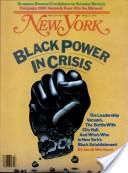
April 23, 1979.
April 23, 1979.
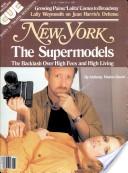
March 16, 1981.
March 16, 1981.
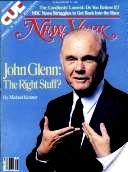
Jan 31, 1983.
Jan 31, 1983.
June 1985.
June 1985.

     At New York, Murdoch initially had a succession of editors in the 1970s, followed by Edward Kosner, of Newsweek, who Murdoch hired in 1980.  Murdoch also acquired another magazine, Cue, a listings magazine that had covered the city for more than 50 years.  Murdoch folded Cue into New York, which added value to New York with a going-out guide, while eliminating a competitor.  New York’s content, meanwhile, tended toward a mix of news- magazine-style, trendy pieces, articles on shopping and consumer topics, and close coverage of the glitzy 1980s New York scene epitomized by financiers Donald Trump and Saul Steinberg.  Other stories focused on national and New York political figures or the major issues of the day.  The magazine was profitable for most of the 1980s and its stories sometimes permeated popular culture, as in mid-1985 when the term “Brat Pack”was coined by New York — used in a cover story to describe a group of young Hollywood film stars that variously included: Emilio Estevez, Anthony Michael Hall, Rob Lowe, Andrew McCarthy, Demi Moore, Judd Nelson, Molly Ringwald, Ally Sheedy, Tom Cruise, C. Thomas Howell, Matt Dillon, Ralph Macchio, Charlie Sheen, and James Spader.  Meanwhile, given New York’s survival and good standing through the 1980s, the earlier worries of Murdoch trashing the magazine seemed over done.  Even his critics would later concede that he did not fundamentally change New York magazine.

Village Voice, March 1981.
     “In 1977, I was working for New York magazine when Murdoch bought it,” explained Ken Auletta in a 1995 Frontline documentary for PBS.  “We all feared he would tart up our journalism, so more than 40 of us quit.  But he didn’t care.  And as it turned out, we were wrong.  He didn’t change the magazine.  But some thought he did desecrate the Post.  He made it more conservative and he replaced one quarter of the staff with tabloid warriors from his empire.”

     Over at The Village Voice, meanwhile, many employees there also feared for the paper’s quality under Murdoch, at least initially.  And Murdoch did make a number of personnel changes at the Voice, but largely allowed the paper run itself.  Some found in subsequent years that the Voice had actually become closer to its original form, hitting a steady circulation of about150,000, where it remained for several years.  In 1981, The Voice received a Pulitzer Prize for the feature writing of Teresa Carpenter.

     The biggest changes that Murdoch brought to his acquired New York publications, however, were those that came at the New York Post.


Murdoch’s Post

New York Post's "blackout special" edition, July 14, 1977.
     At the Post, Murdoch initially became an active presence in the newsroom, according to some, especially punching up the paper’s headlines and copy.  Celebrities got more play, too.  Early on, Murdoch’s editors created a “Page Six,” gossip column at the Post, and before long there were stories about Woody Allen’s love life, ice skater Dorothy Hamill dating Dean Martin’s son, and a piece noting that Muhammad Ali wanted to star in an all-black remake of Ben-Hur.  In March 1977, The Post ran 21 items on Farrah Fawcett-Majors, then a big star of the popular Charlie’s Angels TV show.  Stories at the Post also became shorter; photos and headlines, larger.  And as it turned out, the summer of 1977 was a ripe time for Murdoch-styled journalism, beyond just celebrities.

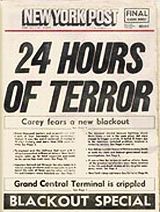
     First, it was the summer of the great New York city blackout of July 13-14, 1977 that created near panic in the city for about two days, during which the city suffered heavy looting and civil unrest.  Over 3,000 people were arrested.  “They [The New York Post] handled the blackout stories by exaggeration and by scare headlines over their stories and on their front pages,” recalled Thomas Kiernan on a PBS Frontline TV documentary.  “The impression was created that there was an impending threat of a kind of race war in New York.”  The Post published a “Blackout Special” on the first day following the blackout with the giant front-page headline: “24 Hours of Terror,” also noting in smaller headlines that New York Governor Carey “fears a new blackout” and that Grand Central Station was “crippled.”  Inside the paper was a special pullout section headlined, “A City Ravaged.”  New York City’s deputy mayor, Osborn Elliott, sent a letter to Murdoch during the crisis suggesting his paper had made the situation worse.  Mayor Abe Beame was more direct, calling Murdoch an “Australian carpetbagger” who “came here to line his pockets by peddling fiction in the guise of news.”  Across town, at the rival Daily News, Pete Hamill wrote: “Something vaguely sickening is happening to that newspaper, and it is spreading through the city’s psychic life like a stain.”

NY Post “Son-of-Sam” story, August 10, 1977.
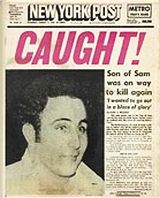
     The second big story for the New York Post and other New York papers that summer was the “Son-of-Sam” murder spree.  “Son of Sam was just a godsend for the Post,” said James Brady ” — you know, a good serial killer.  He was targeting people in lover’s lane, primarily attractive young women of a certain physical description, and he was sending these wacky notes.”  Steve Dunleavy, who covered that story for the Post, added that Son of Sam “really changed the city” during the killer’s rampage.  The sale of locks and guns soared.  “The Son of Sam virtually gave New York City this massive nervous breakdown,” said Dunleavy.  And Murdoch’s Post was in the thick of it, whipping up the fear and fervor.  “It was half truth, half speculation,” said Thomas Kiernan.  “That was Murdoch journalism.”  Among the headlines the Post ran as the killer increased his range in city was one on August 1st that declared: “No One Is Safe from Son of Sam.”  On August 10, 1977, when the police finally caught Son of Sam — whose name was David Berkowitz  — Murdoch’s Post ran the banner headline shown above.  Inside this edition, the Post ran sixteen related stories along with 36 photographs.  There was also the first in a series of installments from a crime novel “that might have inspired” the Son of Sam killer.  The New York Post that day sold more than 1 million copies, nearly twice its average daily circulation.

August 18, 1977 NY Post Elvis Presley story & drug revelations from Steve Dunleavy book.
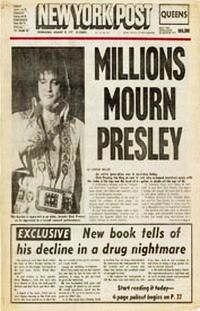
     After Son of Sam, it was on to other stories.  The August 17th, 1977 issue of the New York Post — like other newspapers that day — ran a front-page story on the death of rock ‘n roll singer, Elvis Presley.  But the Post had a special angle on the Elvis story, thanks to reporter Steve Dunleavy, whose book “Elvis: What Happened?” had just been published.  Excerpts from the controversial book, including allegations of Presley’s extensive drug use, had been slated to run the following week.  However, with Presley’s death, the Post printed the first installment in its paper that day, with a front page box boasting “exclusive ” material along with headline: “New Book Tells of His Decline in Drug Nightmare.”  The story helped push the relatively unknown book into the spotlight.

     In addition to the 1977 front-page stories covering Elvis, the blackout, and Son-of-Sam, Murdoch also put his Post squarely in the middle of the New York city politics — and particularly so in the promotion of Ed Koch for mayor.  Koch, then a U.S. Congressman, later recalled in a PBS Frontline documentary, a phone call he received one day in 1977 from Murdoch:

…When the phone rang, the voice on the other end said something like, “Congressman Koch, please.”  I said, “Speaking.”  He said, “Congressman, this is Rupert,” and I guess I was still a little sleepy maybe.  I said to myself, “Rupert?  Rupert?  Rupert’s not a Jewish name.  Who could be calling me at 7:00 o’clock in the morning named Rupert?”  And then suddenly, because he was speaking, I realized it was Rupert, the Australian.  I mean, the voice came through.  And I said, “Yes, Rupert?”  He said, “Congressman, we’re going to endorse you today on the front page of the New York Post and I hope it helps.”  I said, “Rupert, you’ve elected me.”

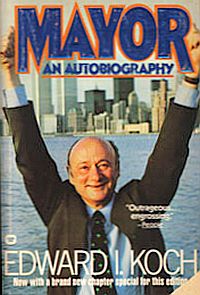
Ed Koch: Former U.S. Congressman who Rupert Murdoch’s NY Post helped elect mayor in 1977. Click for book.
     Ken Auletta added, that The Post did not just support Koch, “it anointed him.”  Koch would also reiterate in later interviews that the Post’s endorsement transformed his campaign.  “I wouldn’t have won without it,” he would later tell The New Yorker’s John Cassidy.

     In 1977, Koch ran in the Democratic primary against incumbent mayor Abe Beame.  Also in the primary were candidates Bella Abzug, Mario Cuomo, and others.  Koch ran to the right of the other candidates, on a “law and order” platform, using the blackout and crime as major issues, promising to restore public safety.  Still, Rupert Murdoch’s decision to have the Post endorse Koch in both the primary and the general election was key. 

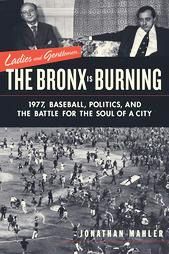
     According to one poll, only 4% of voters even knew who Koch was before Murdoch’s Post endorsed him. Koch proceeded to win the initial vote in the Democratic primary as well as a runoff between he and Cuomo. In the general election, too, Koch prevailed, not only crushing Roy M. Goodman, the Republican candidate, but also beating Cuomo for a third time, as Cuomo ran on the Liberal Party ticket. Journalist Jonathan Mahler, who would write the 2005 book The Bronx is Burning, later observed: “Murdoch had wagered that Koch represented his best shot at becoming a kingmaker in his new town.”

Jonathan Mahler’s book on 1977 also covers Rupert Murdoch & the NY Post. Click for copy.
     Murdoch’s Post, meanwhile, would continue to collect criticism for its political coverage, both during the 1977 mayoral race as well as subsequent gubernatorial and presidential elections.  During the month before the 1977 mayoral primary, the Post’s early editions ran nothing unfavorable about Ed Koch, but there were unflattering stories about Koch’s opponents, including Mario Cuomo.  One of the latter used the headline, “The Blond Millionairess Whose Big Bucks Back Cuomo.”  Koch also received more favorable front-page headlines and more front-page ink in the Post than all of the other candidates, including the incumbent, Mayor Abraham Beame, who had already lashed out at Murdoch, calling him an “Australian carpetbagger.”

     Ken Auletta, later writing for the New Yorker, would also observe: “When Murdoch endorsed Edward I. Koch for mayor…, his support spilled over onto the news pages of the Post, with the paper regularly publishing glowing stories about Koch and sometimes savage accounts of his four primary opponents.”  But after the election, adds Auletta, “fifty of the sixty reporters on the paper signed a petition of protest to Murdoch.”  Murdoch reportedly invited them to quit, and twelve did.

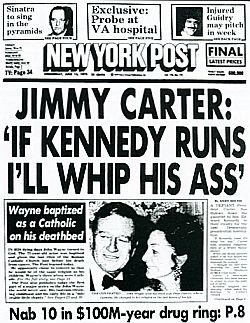
The New York Post was one of a few newspapers to run Jimmy Carter’s June 1979 quote about Ted Kennedy on its front page.
     As the 1980 presidential race was gearing up, The Post would sometimes jump into the fray with a controversial front page, as it did in the June 1979 example at left when incumbent Democratic president Jimmy Carter and U.S. Senator Edward Kennedy appeared to be the likely contestants for the Democratic nomination.  The Post was one of the few newspapers nationally to run the full quote on its front page.  On television that evening, the CBS’s Evening News substitute anchor, Bob Schieffer, alluded to Carter’s remark without quoting it directly, as a copy of the New York Post’s front-page headline was projected on a screen behind him.

     Later in the 1980 presidential race between Carter and Ronald Reagan, Murdoch’s Post supported Reagan.  And some of the Post‘s news columns during the campaign used headlines that tilted to Reagan such as: “Reagan: I’ll Save the Middle Class” — a headline which ran in red ink on the front page.  Other Post stories featured celebrities for Reagan but not Carter, with headlines such as, “Stars Want Ron to Get the Part.”  The Post also ran a headline the day before the Reagan-Carter election that said, “Kohmeni Pulls Strings,”a slam on Carter’s then difficult going with a hostage situation, then a hot-button election issue.

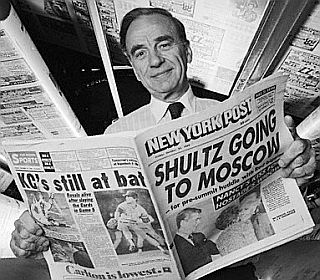
Rupert Murdoch in the New York Post press room with a copy of a Ronald-Reagan era edition of the paper, 1980s.
     In January 1982, a front-page headline in the Post proposed “Ed Koch for Governor” even though Koch had not entered the race.  In fact, ten days earlier in the Post’s discussion of some11 possible candidates, Koch wasn’t even mentioned.  But the Post charged ahead on behalf of Koch.  It invited readers to fill out Koch-for-Governor coupons on its news pages every weekday for the two weeks.  Simultaneously, the Post ran news headlines such as, “Apple Loves Koch.”  Mayor Koch eventually entered the gubernatorial primary, which he proceeded to lose to Mario Cuomo.  Still, Cuomo was steamed about the ink the Post had given Koch.  When most papers endorse candidates, Cuomo explained, “you get one column on the editorial page.  With Rupert, he turns the whole paper over to you.”

     In any case, within five years of making his New York acquisitions, Rupert Murdoch had become something of a political broker and kingmaker, both locally and nationally, by virtue of his media holdings.  And there was much more to come.  “Murdoch says he loves newspapers because they give him the power to help shape the public mind and, as always, he loves to win,” observed Ken Auletta in the 1995 Frontline documentary.  Robert Spitzler, who had been managing editor at the New York Post, added in that same documentary:

“Rupert is a power junkie, in the sense that he enjoys the company of people with power. He also holds them in a certain degree of contempt…

When Rupert first came to New York, he was an Australian of no particular reputation. He bought the New York Post, suddenly he becomes an intimate, so to speak, with mayors, with governors and the president. You can’t ignore a guy who runs a New York newspaper….”

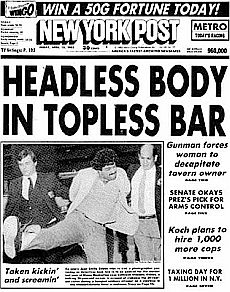
The New York Post’s “Headless Body In Topless Bar” headline of April 15, 1983. Click for book.
     Meanwhile, out on the newsstands, Murdoch’s New York Post continued to shock with the best of them, using sensational and gritty headlines to sell its papers.  One of the all-time classics in the outrageous headline department is the New York Post’s April 1983 classic, “Headless Body in Topless Bar,” shown at left, which described a robbery at a Brooklyn strip club in which the gunman herded all the customers into one room, shooting and decapitating the tavern owner.

     Other front page headlines at the Post could play to the popular hero of the moment, such as New York city subway rider Bernie Goetz who turned to vigilantism in December 1984 when he shot four would-be muggers on the New York subway.  The incident made headlines for months at the Post and elsewhere.  In 1985, when Goetz turned himself in, the Post ran the front-page headline, “I Am Death Wish Vigilante.”  Other classic front-page headlines in the Post during the first Murdoch era ran the gamut of stories — crime, politics, sex, sports and scandal.  The Post in recent years apparently became quite happy with the notice its front-page headlines received, as it compiled a collection of them in a 2008 book using the title, Headless Body in Topless Bar: The Best Headlines from America’s Favorite Newspaper.


Change & Sell Off

     Rupert Murdoch’s media reach in the 1980s and 1990s was extending more into broadcast and satellite television, although print and publishing would remain important to Murdoch.  Still, his 1976-77 New York publishing acquisitions — the New York Post, New York magazine, The Village Voice — as well as his San Antonio newspapers and supermarket tabloid, The Star, were all sold off during the late 1980s and early 1990s for various reasons.  Among these sell-offs, however, the New York Post would be re-acquired by Murdoch later.  More on that in a moment.

Rupert Murdoch, against a wall of his various publications at his New York Post office, 1985.
     In September 1985, Murdoch became a naturalized U.S. citizen primarily to satisfy legal requirements enabling him to become an owner of American television stations.  In that year, Murdoch acquired 20th Century Fox film studios as well as $1.55 billion worth of TV stations in New York, Los Angeles, Chicago, Dallas, Houston, Boston and Washington, DC.  These stations then reached some 22 percent of all television households in the U.S., and combined with the Fox film studio, they provided the structure and distribution network for studio programs and a fourth U.S. broadcast television network, the Fox Broadcasting Co.  Murdoch would continue buying up newspapers, however, as he acquired several in 1987 and also U.S. book publisher Harper & Row, combining that publisher two years later with another, Collins, to form HarperCollins.  Murdoch’s News Corp. by then was the world’s largest newspaper publisher, controlling, for example, about 60 percent of Australian newspapers and thirty-five percent of U.K. newspapers.  In 1989 he also began Sky television in the U.K., an expensive undertaking in the subscription satellite TV business.  In the course of all the media buying and selling, Murdoch was incurring debt and running up against regulatory restrictions.

     In 1985 he put the Village Voice up for sale when the U.S. Federal Communications Commission (FCC) blocked his purchase of a New York radio station unless he sold off one of his New York papers.  So at that point, he sold the Voice to Leonard Stern, heir to the Hartz Mountain pet food company, for $55 million.  But Murdoch was also confronting cross-ownership media rules in other parts of his burgeoning U.S. empire — and in the process, coming up against some unfriendly politicians. Among the latter was U.S. Senator Ted Kennedy, who Murdoch’s papers and TV stations had covered in some unflattering ways, including dredging up and re-broadcasting some old news about Kennedy’s 1969 Chappaquiddick, Massachusetts automobile accident, in which a Senate aide named Mary Jo Kopechne had been killed.

     Murdoch, however, had enjoyed a “temporary” waiver under FCC rules enabling him to own both a newspaper and a broadcast station in the same city.  Murdoch profited from that waiver in New York, Boston, and other markets where he owned newspapers and broadcast stations.  However, by the late 1980s,One headline in the  Herald read: “Kennedy’s Vendetta,” calling the Sen- ator “fat boy” in a front- page editorial.   Ted Kennedy and Senator Fritz Hollings backed a rider to a budget bill that ordered the FCC to strictly enforce the media ownership rules, eliminating waivers such as that held by Murdoch.  So Murdoch went to war.  He turned his Boston Herald and New York Post headline writers loose on Kennedy.  One headline in the Herald read: “Kennedy’s Vendetta” and included some prose in a front-page editorial calling Kennedy “fat boy.”  The New York Post ran one headline during the controversy that announced, “It’s War on Post Busters.”  In addition, Murdoch went on CNN’s “Crossfire” TV show to publicly plead his case.  “We’re keeping the Boston Herald in spite of Senator Kennedy,” he said.  Murdoch explained he would sell his small Boston TV station if necessary, but keep the newspaper.  However, in the end, Murdoch was forced to sell off the Boston Herald.  In New York, he would also sell off the New York Post for $37.6 million, as he could not give up his New York TV station since it was the flagship for his new Fox television network.  But Murdoch wasn’t finished with the New York Post in 1988; he would return.  In the meantime, however, he went shopping elsewhere, acquiring TV Guide and others at Triangle Publications for $3 billion.

After Rupert Murdoch re-acquired the New York Post in 1993, creative headlines continued to appear, as in the Barry Bonds “hypodermic needle” home run record story.
     By the early 1990s, feeling the bite of mounting debt in some of his other ventures, Murdoch began selling off a few more of his U.S. publishing properties.  Among these was the supermarket tabloid, The Star, which he sold to the GP Group, the National Enquirer’s parent, for $400 million in cash and stocks.  At the time, the Star’s 3.6 million weekly circulation was just below National Enquirer’s 4.1 million.  Murdoch also sold off his San Antonio newspapers in 1992 — by this time, combined into one paper, The San Antonio Express-News.  Murdoch’s News Corp was then struggling from some earlier debt restructuring and needed cash.  So he sold The San Antonio Express-News to the Hearst Corporation for $185 million.

     Through the 1980s and 1990s, Murdoch was buying and selling media properties as the situation and his expansion plans required.  In 1993, the New York Post came on the block again, as it was in poor shape financially and nearly bankrupt.  But in order for Murdoch’s News Corp. to acquire the Post, a waiver from the same FCC rules that required him to shed the paper five years earlier was required.  This time, a number of politicians, including Democratic New York governor Mario Cuomo, came to Murdoch’s support and persuaded the FCC to grant him a permanent waiver from the cross-ownership rules.  Without that ruling, the New York Post would have shut down, but instead, under Murdoch’s renewed direction, the Post more or less picked up where it left off when Murdoch first owned it.  In recent years, criticism of the paper’s style and sensationalism has appeared in selected articles and at various websites, including one list of documented 1997-2009 items at Wikipedia.org.

Rupert Murdoch on the July 2006 cover of Wired magazine: “Rupert Murdoch, Teen Idol! – News Corp & The Future of My Space”(later sold for big loss; “huge mistake,” Murdoch would later say).

     Rupert Murdoch, meanwhile, continued to build his media empire through the 2000s, acquiring most notably in recent years, MySpace.com in 2005 for $580 million, and the Wall Street Journal in July 2007 for $5 billion. The MySpace deal, however, proved to be a bad bet for Murdoch, and by June 2011 that company was sold for a gigantic loss, fetching only a reported $35 million sales price. Some compared it to another bad deal of the new internet age – the Time-Warner purchase of AOL, covered in the Ted Turner story at this website.

For additional stories at this website on newspaper and magazine history, see for example:

“Empire Newhouse, 1920s-2012” (the rise of Sam Newhouse and family as newspaper/ magazine/ publishing powers and “culture makers,” with magazines such as Vanity Fair and The New Yorker, among others);

“Newsweek Sold!, 1961″ (history of the Washington Post’s acquisition of Newsweek, Ben Bradlee/Phil Graham role, and more recent history through Newsweek’s demise and the Jeff Bezos acquisition of the Washington Post);

“FDR & Vanity Fair, 1930s” (politics & publishing during the New Deal era);

“Ted Turner & CNN, 1980s-1990s” (rise of Turner’s all-news cable TV channel, CNN, and his impact on the media industry); and

“Rockwell & Race, 1963-1968,” (Norman Rockwell’s art on this topic at The Saturday Evening Post and Look magazine).

Thanks for visiting – and if you like what you find here, please make a donation to help support the research and writing at this website. Thank you. – Jack Doyle

Please Support
this Website

Donate Now

Thank You

____________________________

Date Posted: 25 September 2010
Last Update: 25 July 2021
Comments to:  jackdoyle47@gmail.com

BlueSky: jackdoyle.bsky.social

Article Citation:
Jack Doyle, “Murdoch’s NY Deals, 1976-1977,”
PopHistoryDig.com, September 25, 2010.

____________________________


Sources, Links & Additional Information

Michael Wolff’s book, “The Man Who Owns The News: Inside the Secret World of Rupert Murdoch,” 2018 paperback, Vintage, 480 pp. Click for copy.
Irwin Stelzer’s 2018 book, “The Murdoch Method: Observations on Rupert Murdoch's Management of a Media Empire,” Pegasus Books,  368 pp.  Click for copy.
Irwin Stelzer’s 2018 book, “The Murdoch Method: Observations on Rupert Murdoch's Management of a Media Empire,” Pegasus Books, 368 pp. Click for copy.
Harold Evans’ book, “Good Times, Bad Times: The Explosive Inside Story of Rupert Murdoch,” 2011 paperback, Open Road Media, 602pp.  Click for copy.
Harold Evans’ book, “Good Times, Bad Times: The Explosive Inside Story of Rupert Murdoch,” 2011 paperback, Open Road Media, 602pp. Click for copy.
Gabriel Sherman’s book, “The Loudest Voice in the Room: How the Brilliant, Bombastic Roger Ailes Built Fox News--and Divided a Country,” 2017 paperback, 576 pp.  Click for copy.
Gabriel Sherman’s book, “The Loudest Voice in the Room: How the Brilliant, Bombastic Roger Ailes Built Fox News--and Divided a Country,” 2017 paperback, 576 pp. Click for copy.
Neil Chenoweth’s 2002 book, “Rupert Murdoch: The Untold Story of the World's Greatest Media Wizard,” Crown Business, 416 pp.  Click for copy.
Neil Chenoweth’s 2002 book, “Rupert Murdoch: The Untold Story of the World's Greatest Media Wizard,” Crown Business, 416 pp. Click for copy.
Brian Stelter’s 2020 book, “Hoax: Donald Trump, Fox News, and the Dangerous Distortion of Truth,” Atria/One Signal, 368 pp.  Click for copy.
Brian Stelter’s 2020 book, “Hoax: Donald Trump, Fox News, and the Dangerous Distortion of Truth,” Atria/One Signal, 368 pp. Click for copy.

“The Battle of New York,” Time, Monday, January 17, 1977.

David Gelman, “Press Lord Captures Gotham,” Newsweek, January 17, 1977.

“The Press: Krusty Kay Tightens Her Grip,” Time, Monday, February 7, 1977.

“The Press: California’s Magazine War” (re: New West magazine), Time, Monday, August 29, 1977.

David Gunzerath, “Rupert K. Murdoch, U.S./ Australian Media Executive,” The Museum of Broadcast Communications.

“New York Post,” Wikipedia.org.

Bill Abrams, “Murdoch Will Sell the Village Voice to Stern of Hartz – Controversial Chief of Firm That Produces Pet Food to Pay $55 Million,” Wall Street Journal, June 21, 1985.

Jennifer Senior, “Tabloid Queen” (Book Review of, The Lady Upstairs: Dorothy Schiff and The New York Post, by Marilyn Nissenson, St. Martin’s Press), New York Times, April 22, 2007

James Brady, “On Media: Feats Of Clay,” Forbes, October 5, 2006.

Kurt Andersen, ‘Clay Felker, 1925-2008,” New York, July 1, 2008.

Joe Garofoli, “Media Maestro Clay Felker Dies At 82,” San Francisco Chronicle, July 2, 2008.

Tom Wolfe, “A City Built of Clay,” New York, July 6, 2008

Sarah Bernard & Aaron Latham, “My God, What Trouble You Could Cause!” (re: Clay Felker), New York,  July 6, 2008.

“A Look Back at Memorable Covers From Felker’s Career,” New York, July 6, 2008.

Robert J. Bliwise, “The Master of New York: Clay Felker,” Duke Magazine, Duke Universtiy, date

Robert Struckman, “Clay Felker, Master of the Magazine,” NewWest.net, July 1, 2008.

“The Power Game”, New York Magazine (cover story), December 23, 1968. Click for related book by Clay Felker (ed).”

Stacy Perman, “The Heart [symbol] and Mind of Milton Glaser,” Business Week, January 4, 2006, and Slide Show.

Michael Wolff, “’35 Years’ The Story of New York,” New York, March 31, 2003.

Editors, New York Magazine, Highbrow, Lowbrow, Brilliant, Despicable: Fifty Years of New York Magazine, 2017 edition, Simon & Schuster; illustrated, 432 pp. Click for copy.

“Who’s Afraid of Rupert Murdoch?,” Frontline, PBS, WGBH Educational Foundation, 1995.

“Village Voice Media, Inc.,” International Directory of Company Histories, Vol. 38. St. James Press, 2001.

James Fallows, “The Age of Murdoch,” Atlantic Monthly, September 2003, pp. 81-98.

Robert Kolarik, “San Antonio Express-News History, Part 3: Wild In The Streets,” San Antonio Express-News, July 10, 2008.

“The Sun (United Kingdom),” Wikipedia.org.

“Page Three,” Wikipedia.org (for more on topless photos used by The Sun)

Deirdre Carmody, “Clay Felker, Magazine Pioneer, Dies at 82,” New York Times, July 1, 2008.

“Founding Father of New Journalism,” Duke University, 2008.

Deirdre Carmody, (1995-04-09). “Conversations / Clay Felker; He Created Magazines by Marrying New Journalism to Consumerism,” New York Times, April 9, 1995.

“Clay Felker,”Duke University (use Search option there).

Dennis Mclellan, “Clay Felker, 82; Editor of New York Magazine Led New Journalism Charge,” Los Angeles Times, July 2, 2008.

Marc Weingarten, The Gang That Wouldn’t Write Straight, 2006.

Laurence Zuckerman, Ted Gup, and Lawrence Malkin, “Fat Boy vs. the Dirty Digger,” Time, Monday, January 18, 1988.

John Cassidy, “Murdoch’s Game,” The New Yorker, October 16, 2006.

Ken Auletta, “Promises, Promises,” The New Yorker, July 2, 2007.

Martin Phillips, “We Are 40 Tomorrow,” The Sun, November 16, 2009.

Mary Braid, “Page Three Girls – The Naked Truth,” BBC News Online, Tuesday, September 14, 2004.

Torin Douglas, “Forty Years of The Sun,” BBC News Online, Tuesday, September 14, 2004.

David Blum, “Hollywood’s Brat Pack,” New York, June 10, 1985, pp. 40-47.

Jonathan Mahler, Ladies and Gentlemen, The Bronx Is Burning: 1977, Baseball, Politics, and the Battle for the Soul of a City, New York: Farrar, Straus and Giroux, March 2005, 368 pp.

Mitchell Stephens, “His News Is Bad News,” Newsday, April 2, 1993.

“A Fun Bookstore Find: Collected NY Post headlines,” VisualEditors.com, Tuesday, January 19, 2010.

Jonathan Mahler, “What Rupert Wrought,” New York, May 21, 2005

“50 Years/50 Covers,” VillageVoice.com.

“Press: Whip His What?,” Time, Monday, Jun. 25, 1979

Steve Stecklow, Aaron O. Patrick, Martin Peers & Andrew Higgins, “Calling the Shots: In Murdoch’s Career, a Hand on The News; His Aggressive Style Can Blur Boundaries; ‘Buck Stops With Me’,” Wall Street Journal, June 5, 2007.

Allan R. Gold, “Kennedy and Paper Battle in Boston,” New York Times, January 7, 1988.

Allan R. Gold, “Kennedy vs. Murdoch: Test of Motives,” New York Times, January 11, 1988.

New York Post Staff, Headless Body in Topless Bar: The Best Headlines from America’s Favorite Newspaper, March 25, 2008, 208 pp.

Steven Cuozzo, It’s Alive! How America’s Oldest Newspaper Cheated Death and Why it Matters, New York: Times Books, 1996, 342 pp. Click for copy.

Paul Farhi, “Murdoch, All Business: The Media Mogul Keeps Making Bets Amid Strains in His Global Empire.” Washington Post, February 12, 1995.

David M. Alpern, “What Makes Rupert Run?” Newsweek, March 12, 1984.

Thomas Kiernan, Citizen Murdoch: The Unexpurgated Story of Rupert Murdoch–The World’s Most Powerful and Controversial Media Lord, 1986, Dodd Mead, 337 pp. Click for copy.

Thomas Moore and Marta F. Dorion, “Citizen Murdoch Presses for More.” Fortune, July 6, 1987.

William H. Meyers, “Murdoch’s Global Power Play,” New York Times, June 12, 1988.

Roger Cohen, “Rupert Murdoch’s Biggest Gamble.” New York Times, October 21, 1990.

Richard Brooks, “Murdoch: A Press Baron Re-Born.” Toronto Star, September 12, 1993.

Elizabeth Jensen and Daniel Pearl, “One Dogged Lawyer Shakes Murdoch Empire.” Wall Street Journal, April 6, 1995.

Nick Davies, Hack Attack: The Inside Story of How the Truth Caught Up with Rupert Murdoch, 2014, Farrar, Straus and Giroux, 448 pp. Click for copy.

Christopher Williams, The Battle for Sky: The Murdochs, Disney, Comcast and the Future of Entertainment, 2019, Bloomsbury Business, 272 pp. Click for copy.

____________________________