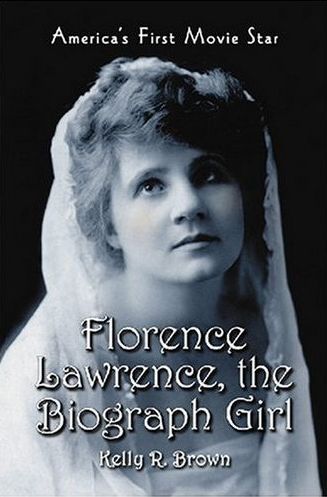
Cover of Kelly Brown’s book on Florence Lawrence, Hollywood’s first movie star. 2007 paperback edition.
The film studios then were out to produce a cheap, standardized product and part of the strategy was to keep actors anonymous and low paid. Indeed, most actors of that day focused on the Vaudeville stage, and many, in fact, thought it down right horrid to work in the “flickers.”
But during the early1900s, the seeds of change were being sown, as a few actors tried some self-promotion in the trade press, and film exchange owners were also beginning to see that audience familiarity with actors was good for business. Still, one of the most popular actresses of that day was Florence Lawrence of the Biograph Studios. But Lawrence was not known to movie fans by her real name. A Canadian in her twenties, Lawrence had already made 38 films for the Vitagraph Co. before coming to Biograph. But even at Biograph, though her face was well known, she was simply known to the public as “The Biograph Girl.” Then came a film producer named Carl Laemmle.
Laemmle, born into a Jewish family in 1860s Germany, had come to the U.S. when he was 17. He opened a Chicago nickelodeon some years later, and moved into film distribution in the Midwest. By 1909, after fighting with inventor and film-maker businessman Thomas Edison over film distribution rights, he established his own film production company, the Independent Motion Picture Company of America, also known as IMP. “Biograph Girl” Florence Lawrence, meanwhile, had a falling out with her employer, and Laemmle hired her to his company. Laemmle then went about creating some first-of-a kind publicity to introduce her.
Biograph Girl Dead !
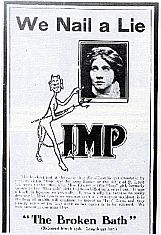
Copy of ad on the 'Florence Lawrence incident,' which mentions IMP's new film.
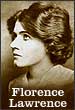
The new 'star.'
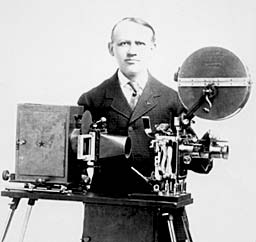
Carl Laemmle, founder of the IMP film company, staged the Florence Lawrence event, making her America's first 'film star'.
…A mere two months after Lawrence’s live appearance in St. Louis, Moving Picture World’s “Man About Town” [magazine column] professed astonishment at “the interest the public has taken in the personality of many of the picture players.” Letters allegedly poured into the offices of film manufacturers and exchanges, from both men and woman, asking for autographed photos of their favorite leading actors. One actress [Florence Turner] claimed to have received three thousand offers of marriage just three months after the Lawrence incident. By the end of 1910, Moving Picture World’s “Picture Personalities” column profiled Florence Turner of Vitagraph, Mary Pickford of Biograph, and Pearl White of the Powers film manufacturing company. Even if it did not invent the film star, the Lawrence incident signaled to the industry that the star had arrived.
“Famous Players”
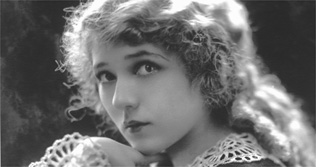
Mary Pickford, who followed Florence Lawrence as the ‘Biograph Girl,’ soon became a giant star with Adolph Zukor.
Zukor soon found himself running a business that sought to bring noted stage and Vaudeville actors to the screen, one of whom was a child actress named Mary Pickford.
Pickford, in fact, had initially followed Florence Lawrence as the Biograph Girl. However, by 1913 the Famous Players Film Company was established, producing The Prisoner of Zenda. That year, Zukor told Mary Pickford’s mother, “if feature pictures succeed, we expect to pay according to the drawing power of the box office.”

Theda Bara, starring in 'Cleopatra.'
Another film maker who helped push the early star system forward in the 1910s was William Fox. A German-Jewish immigrant like Carl Laemmle, Fox had made a fortune in the film exchange business. By 1915, he went into film production as head of the Fox Film Corporation. But Fox needed a star, and his solution was simply to create one.
Fox transformed a somewhat “plain Jane” stage actress named Theodosia de Coppet (Goodman), into the screen’s first ‘vamp’ and million-dollar star, Theda Bara. His early movies with Bara, such as A Fool There Was (1915), produced the funds to help found the Fox Film Corporation, while others with Bara like Cleopatra (1917) helped make Fox a successful studio.
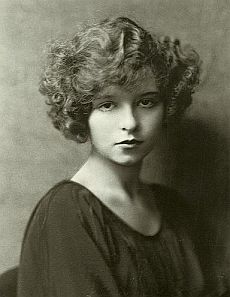
Clara Bow, 1921, among the early film stars signed by Paramount’s Adolph Zukor, an early booster of Hollywood’s ‘star system’.
Adolph Zukor at Paramount, meanwhile, developed many of the leading early film stars. In addition to Mary Pickford, Zukor would also sign Douglas Fairbanks, Gloria Swanson, Rudolph Valentino, Clara Bow, and Wallace Reid. With so many “famous players,” Zukor’s Paramount was able to introduce block booking, which meant that an exhibitor who wanted a particular star’s films had to buy a year’s worth of other Paramount productions. It was this system that gave Paramount a leading position in the 1920s and 1930s. It also later led the government to pursue the company on anti-trust grounds. In any case, it was the early star system that helped build the Hollywood studios into the business giants they would become.
Celebrity & Fan Culture
“The Famous Players were now more important than the Famous Plays,” film historian Robin Cross would later say of the changing film industry in the 1910s. Celebrity culture was on its way, now given a much larger reach in those early days of film promotion. But celebrity culture would go well beyond film, becoming a powerful force in its own right and a key part of entertainment and marketing economics in the years to come.Celebrity culture — born in the early movie star sys-tem of the 1910s, fueled by the urban masses — would go well beyond film & Hollywood. For celebrity culture would not only rise in Hollywood and film, but also in radio, sports, and later television, spawning a host of new specialties and cottage industries, from talent agencies to a vast new advertising industry.
There is, of course, a lot more detail on the history and rise of the Hollywood star system. But it does appear that “mass appeal stardom” first took hold in the film industry of the 1910s in part through the actions of business-wise film makers and promoters like Carl Laemmle, Adolph Zukor, William Fox, and others. This “movie star” phenomenon was soon spread to the urban masses by the eager newspaper and magazine industries, forming a “celebrity press” that stoked the rise of celebrity and fan culture that followed.
See also at this website, “Talkie Terror, 1920s” (the revolutionary arrival of “talking pictures” in Hollywood and what that meant for actors, producers, and the film production process); “Pearl White, 1910s-1920s” (history of a silent film star & early female action figure); and “Anna Q. Nilsson, 1910s-1920s”(Photoplay magazine art, early Hollywood cover girls, and the history of a Swedish immigrant silent film star). For additional film history and celebrity-related story choices see the “Film & Hollywood” category page and the “Celebrity & Icons” category page. Thanks for visiting – and if you like what you find here, please make a donation to help support the research and writing at this website. Thank you. – Jack Doyle
|
Please Support Thank You |
___________________________
Date Posted: 30 October 2008
Last Update: 16 September 2017
Comments to: jdoyle@pophistorydig.com
Article Citation:
Jack Doyle, “A Star is Born, 1910s,”
PopHistoryDig.com, October 30, 2008.
_____________________________
Sources, Links & Additional Information
Robyn Karney (ed.), Cinema Year By Year, 1894-2005, London: Dorling Kindersley, Ltd., 2005, p.79.
“Paramount Pictures,” Wikipedia.org
Eileen Bowser, The Transformation of Cinema, 1907-1915 (History of the American Cinema, 2), Berkeley & Los Angeles: University of California Press, May 1994, 337 pp.
Karen Ward Mahar, Women Filmmakers in Early Hollywood, John Hopkins University Press, 2006, 332 pp.
Kelly R. Brown, Florence Lawrence, The Biograph Girl: America’s First Movie Star, North Carolina, McFarland & Co., 2007, 230 pp.